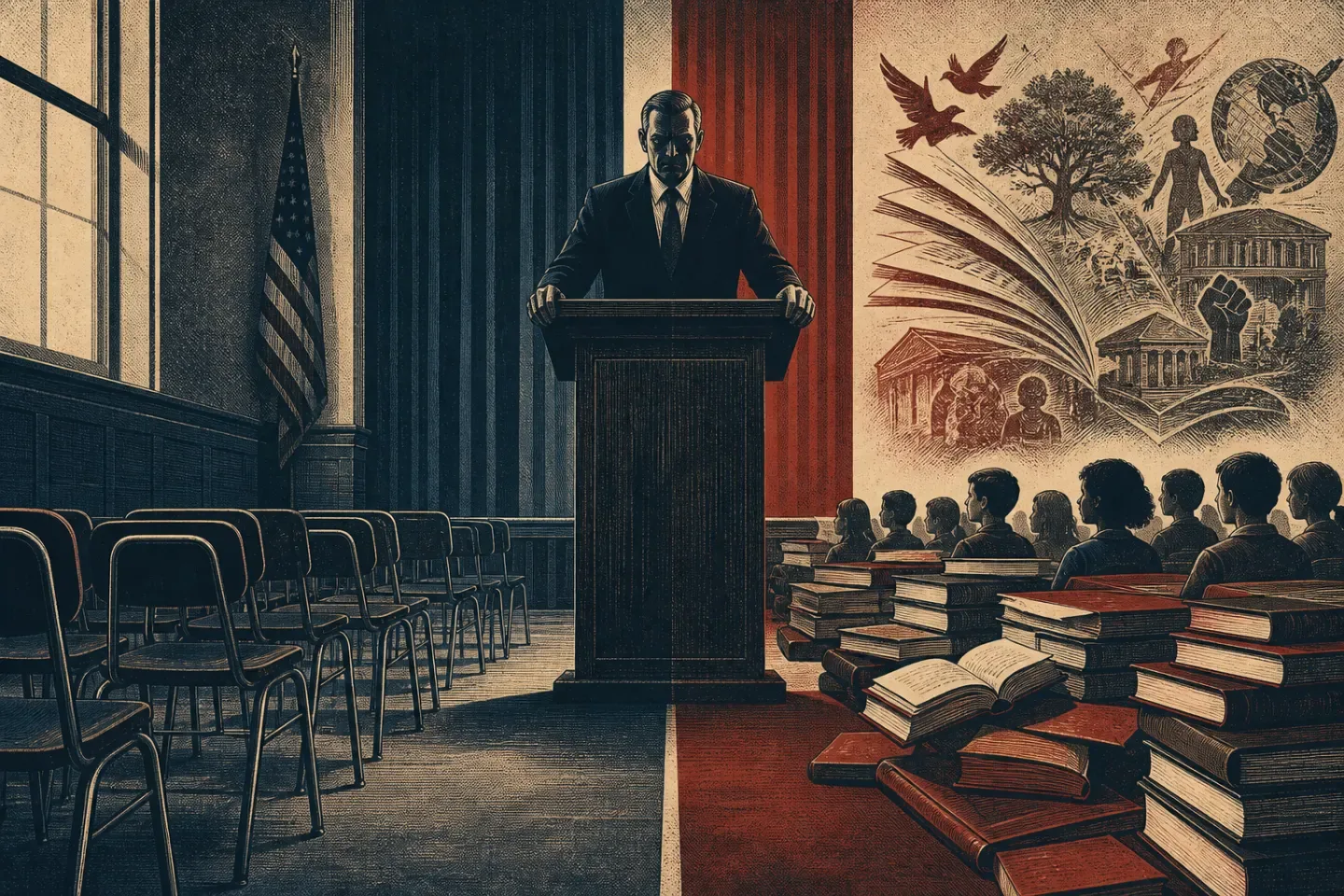
The Cobb County controversy is bigger than one speech. It is about whether parents are still allowed to ask what schools place in front of their children.
Nearly 200 educators in Georgia’s Cobb County school system were reportedly questioned after walking out of Superintendent Chris Ragsdale’s back-to-school address. The dispute erupted after Ragsdale condemned sexually explicit material in schools and argued that adults who object to its removal have no business working in education.
That is an intentionally sharp statement, and teachers are entitled to disagree with a superintendent’s language. What they cannot expect is for the public to ignore the obvious question created by the walkout: What, precisely, were they defending?
The available reporting does not establish that every educator who left the room was protesting the removal of explicit material. Some may have objected to Ragsdale’s rhetoric, the district’s process, or an entirely different part of the address. Those explanations deserve to be heard. But silence and institutional defensiveness will not make the perception problem disappear.
Parents have watched school officials across the country turn straightforward questions about books, curricula and age-appropriate boundaries into ideological combat. They have been told that requesting transparency is censorship, that objecting to graphic material is extremism, and that professional educators should have the final word because they possess credentials parents do not.
Public schools do not work that way. Teachers bring expertise to the classroom, but parents do not surrender their authority at the schoolhouse door. Taxpayers also have a right to expect that disputes involving children will be handled in daylight.
The questioning of educators creates a second concern. A district should determine what happened without treating lawful disagreement as insubordination. Teachers should be able to explain why they left, and the public should be able to evaluate those explanations. Accountability is not achieved by replacing one wall of secrecy with another.
The cleanest resolution is radical transparency: release the complete remarks, identify the materials at issue, explain the district’s standards, and allow the educators who walked out to state their objections in their own words. Let parents see the evidence instead of receiving carefully edited summaries from competing factions.
If the controversy is being misunderstood, transparency will correct the record. If educators truly walked out because a superintendent said sexually explicit material does not belong around children, transparency will reveal that too.
The country’s education establishment has spent years insisting that parents are imagining these conflicts. Cobb County now has an opportunity to prove that public schools still answer to the public. It should take it.
Claire Whitmore is a conservative writer covering culture, family, education, media, and the rapidly changing expectations placed on women in modern America. Her work examines the intersection between politics and everyday life, particularly debates surrounding motherhood, relationships, career expectations, schools, and popular culture. Whitmore is skeptical of political movements that treat traditional choices as inherently outdated and argues that genuine freedom requires allowing women to define success for themselves. At The Dispatch Room, she brings a measured but unapologetically conservative perspective to some of the country’s most contentious cultural debates.
Discussion
Loading discussion…