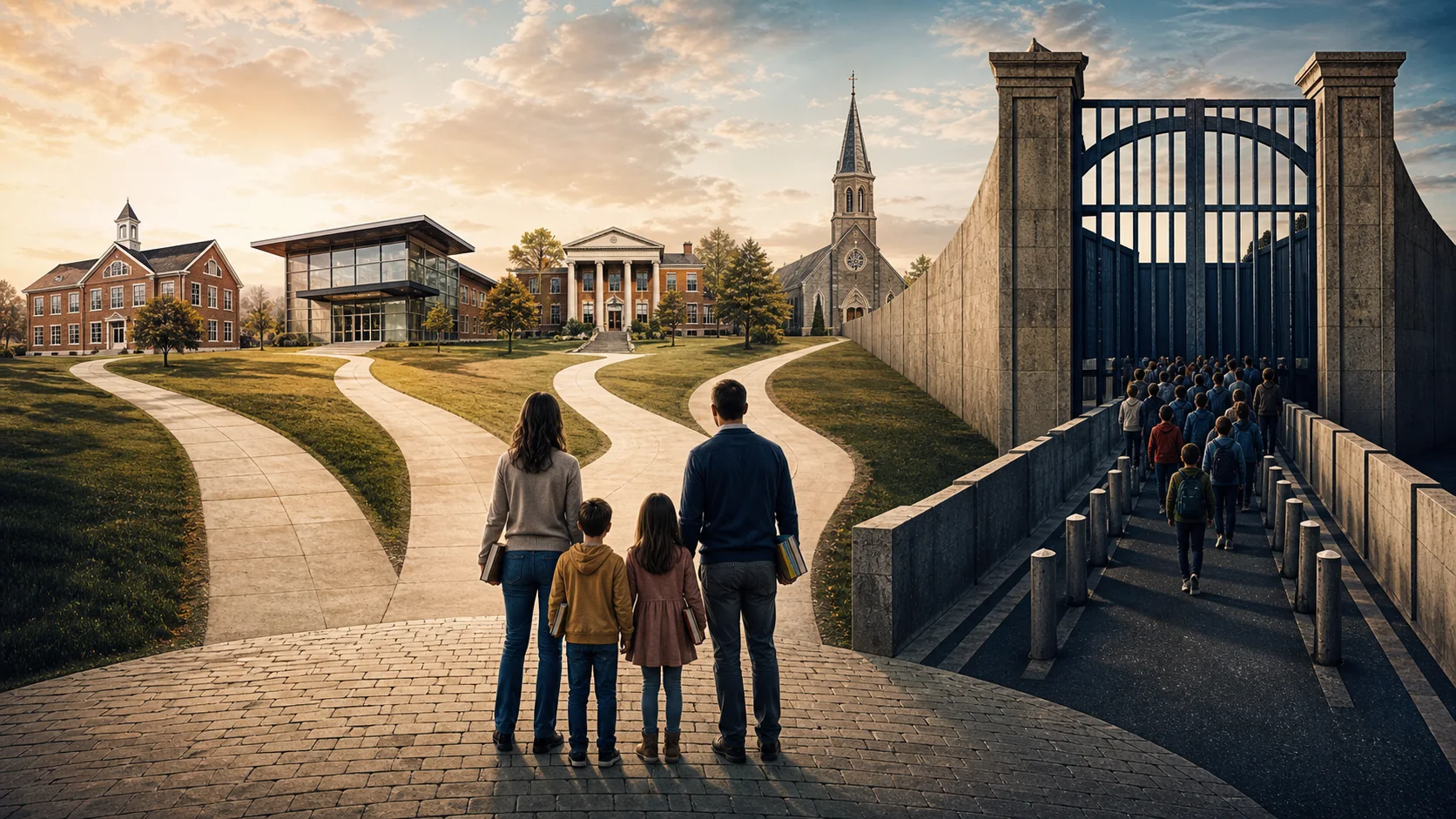
A New York union leader says religious and private education can divide the country. The real threat, apparently, is a family escaping the system the unions control.
Democracy is in danger again.
This time the threat is a parent choosing a school.
New York is debating whether to participate in a federal tax-credit program supporting scholarship-granting organizations. Taxpayers could receive a credit of up to $1,700 for donations, and eligible families could use scholarships for private-school tuition, tutoring, or other educational expenses.
Naturally, the teachers’ unions are alarmed.
Not because the program cuts state funding for public schools. It does not.
Not because religious schools are illegal. They are not.
The stated concern is grander: allowing families to separate into private and religious schools could weaken pluralism and threaten democracy.
Nothing protects freedom like telling families they have one acceptable educational choice.
The Monopoly Discovers Civic Virtue
Teachers’ unions rarely describe themselves as defenders of monopoly power.
They prefer democracy.
It sounds better.
But examine the arrangement they are defending.
Families pay taxes. Government assigns children to schools largely according to address. Unionized systems receive the money. Parents who want something different must often pay again, if they can afford it.
Then, when a proposal gives some of those families assistance, the institutions controlling the existing system announce that social cohesion is at risk.
Whose cohesion?
A pluralistic country does not require every child to receive the same institutional education.
It requires citizens with different beliefs to live under common laws.
Catholic schools, Jewish schools, Islamic schools, independent schools, classical academies, homeschooling families, charter schools, and district schools all exist inside that constitutional order.
Uniformity is not pluralism.
It is uniformity.
Religious Families Are Not a Democratic Threat
The most offensive part of the argument is the suggestion that religious education causes Americans to retreat from democratic society.
New York’s private schools enrolled more than 417,000 students in the most recent school year cited in the debate. Jewish schools served the largest share, followed by Catholic, independent, and Islamic schools.
Those families are not foreign colonies operating inside the state.
They are New Yorkers.
They vote, work, pay taxes, serve communities, start businesses, join the military, care for neighbors, and participate in public life.
The implication that sending a child to a religious school makes a family less democratic should have been buried with the old prejudices that once treated Catholic education as evidence of divided loyalty.
Apparently, some enlightened institutions kept the argument and updated the vocabulary.
Follow the Money and the Power
Union opposition becomes easier to understand when stripped of its civic poetry.
School choice weakens control.
It allows families to compare institutions. It permits them to leave. It forces systems accustomed to guaranteed enrollment to confront dissatisfaction as something more serious than a survey result.
Exit is accountability.
A parent who cannot move, cannot pay private tuition, and cannot obtain a scholarship possesses very little leverage. The district can listen politely and continue exactly as before.
A parent with an alternative is suddenly a constituency rather than a captive.
That is what frightens monopolies.
Not fragmentation.
Competition.
Public Schools Still Matter
Conservatives should not pretend every private school is excellent or every public school is failing.
America needs strong public schools. Millions of families want them, depend on them, and are served well by dedicated teachers.
School choice is not a declaration of war against those teachers.
It is recognition that no single model can serve every child, every family, every disability, every religious conviction, and every educational philosophy.
A good district school has nothing to fear from parents choosing it freely.
A failing system has everything to fear from parents being allowed to leave.
That is precisely why choice matters.
Democracy Begins Before the Ballot Box
Democracy is not strengthened when government institutions train citizens to accept whatever service the system assigns.
It is strengthened when families exercise responsibility, form associations, build institutions, and make meaningful choices.
That is civil society.
Religious schools are part of it.
Private schools are part of it.
Public schools are part of it.
The state does not create pluralism by forcing everyone through the same door.
It protects pluralism by allowing many doors to remain open.
Let Parents Decide
If New York rejects scholarship support, wealthy families will continue choosing private schools. They always do.
The families most constrained will be those without the money to escape a school that does not fit their child.
Union leaders can call that equality.
Parents may have another word for it.
The federal tax-credit proposal is not the abolition of public education. It is a limited mechanism encouraging private donations to help families obtain educational services.
That is not a threat to democracy.
The real threat is an education establishment so confident in its own authority that it treats parental independence as civic disloyalty.
Parents do not belong to the school system.
Children do not belong to the union.
And democracy does not require asking permission before choosing a better door.
Claire Whitmore is a conservative writer covering culture, family, education, media, and the rapidly changing expectations placed on women in modern America. Her work examines the intersection between politics and everyday life, particularly debates surrounding motherhood, relationships, career expectations, schools, and popular culture. Whitmore is skeptical of political movements that treat traditional choices as inherently outdated and argues that genuine freedom requires allowing women to define success for themselves. At The Dispatch Room, she brings a measured but unapologetically conservative perspective to some of the country’s most contentious cultural debates.
Discussion
Loading discussion…