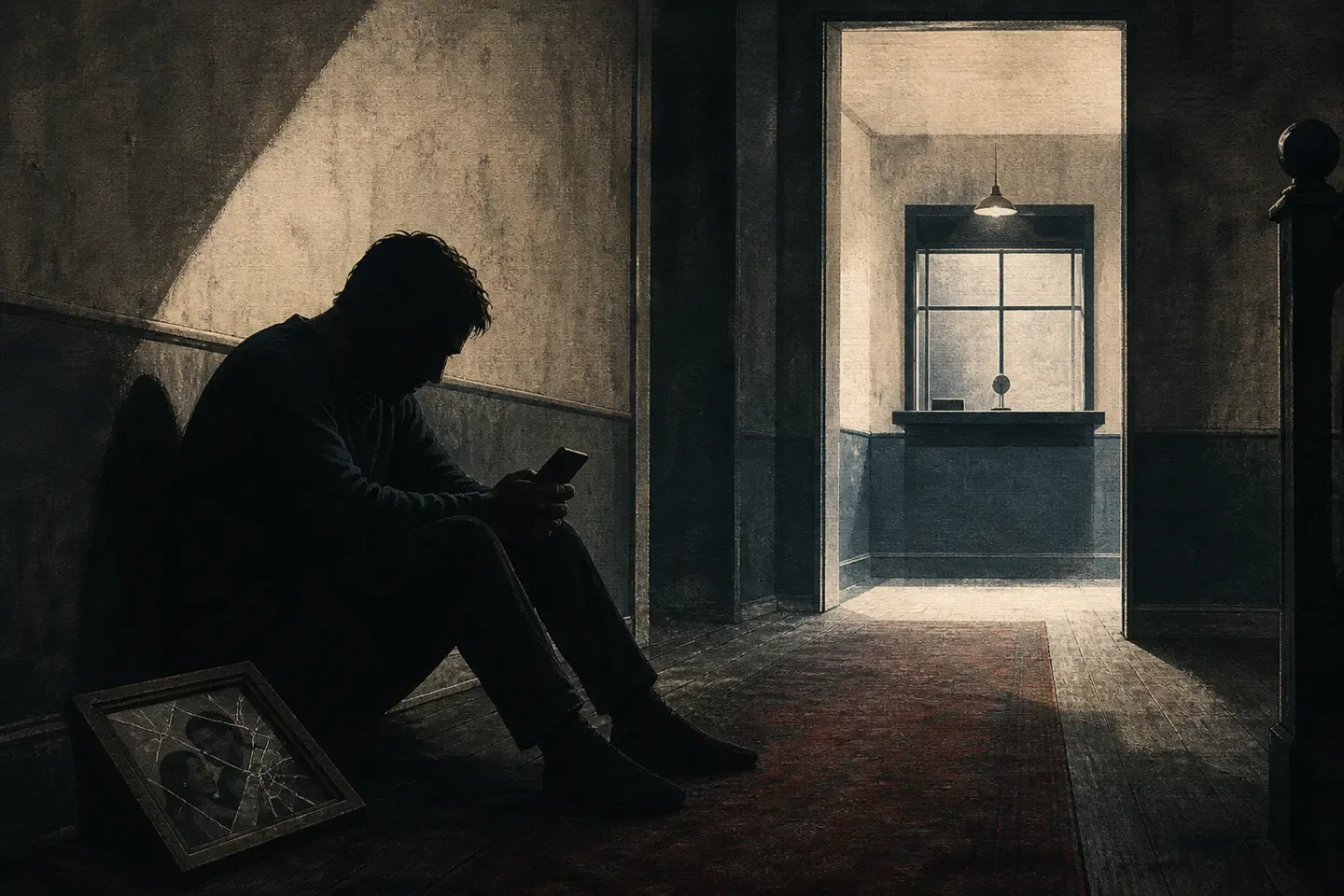
Male victims are real, numerous and often invisible. A support system built around one image of domestic abuse leaves too many men with nowhere credible to turn.
The public has learned an important lesson about domestic abuse: victims do not always leave, bruises are not the only evidence and fear can make an intelligent person behave in ways outsiders do not understand.
Then the victim is a man, and much of that understanding vanishes.
He is asked why he did not walk away. He is reminded that he is probably stronger. If he admits that his partner hit him, threatened him, destroyed property, controlled money or used the children as leverage, the story is treated as embarrassing relationship drama rather than abuse.
The Centers for Disease Control and Prevention calls male victimization a significant public-health problem. Its national survey work has found that nearly one in three male victims experienced contact sexual violence, physical violence or stalking by an intimate partner during their lifetimes and reported a related impact. Those are not fringe numbers, yet the public conversation still treats abused men as exceptions too rare to shape policy.
Physical size does not make a person immune to coercion. A man may know that restraining an attacking partner could leave marks and turn him into the suspect when police arrive. He may fear losing his children, his home or his reputation. He may have nowhere to go, especially if local shelter services are built almost entirely around women.
Psychological abuse can be just as effective against a man as it is against a woman. Isolation, threats, financial control, false allegations and humiliation work because human beings depend on relationships and fear social ruin. Masculinity does not create an invisible shield around the nervous system.
The cultural trap is almost perfect. Men are told to speak about mental health and vulnerability, but a man who says he is frightened of his wife or girlfriend risks becoming a joke. If he stays silent, his silence is taken as proof that male victims barely exist. If he finally responds in anger, everything that came before can disappear from the story.
None of this minimizes violence against women. Women are more likely to suffer severe physical injury and intimate-partner homicide, and any honest policy must account for that danger. Recognizing male victims does not take a bed, a prosecution or an ounce of sympathy away from female victims. A competent system should be able to see both.
The obstacle is not a lack of language. Advocates have spent decades teaching the public about power, control, trauma bonds and the difficulty of leaving. The obstacle is a refusal to apply that language consistently.
Police need training that evaluates evidence rather than assuming the larger person is the aggressor. Service providers need referral networks that do not treat a male caller as a novelty. Courts need to distinguish a pattern of coercive control from a single incident viewed in isolation. Friends and relatives need to stop treating male pain as comedy.
Most of all, men need to know that asking for help will not automatically cost them their dignity.
A society serious about domestic violence cannot define the victim before the facts are known. It cannot insist that abuse is about control rather than strength, then reverse itself when a man is controlled. It cannot celebrate vulnerability as courage in theory and punish it as weakness in practice.
The standard should be mercifully uncomplicated: listen to the claim, examine the evidence, protect the endangered person and hold the aggressor accountable.
No footnote for sex. No smirk. No assumption that a man must be either invincible or guilty.
Abuse is abuse, and a victim does not become less worthy of help because he fails to resemble the victim on the poster.

Naomi Carter is a conservative columnist whose work focuses on women, identity politics, gender, race, media, and the cultural institutions influencing younger Americans. Carter became increasingly skeptical of progressive politics after seeing complex questions of identity reduced to rigid ideological categories. Her writing challenges political orthodoxies on both race and gender while emphasizing individual agency, personal responsibility, free expression, and equal treatment under the law. At The Dispatch Room, Carter frequently examines how political narratives are created, amplified by media and institutions, and ultimately experienced by ordinary people.
Discussion
Loading discussion…