Taxpayers fund America’s national museums. They are entitled to ask why so much institutional history sounds like an indictment written by people embarrassed by the country that pays them.
The people who spent decades insisting that everything is political have suddenly discovered one sacred institution that must remain above politics.
The Smithsonian.
How fortunate for them.
President Trump’s campaign against what his administration calls ideological capture at the Smithsonian has produced the predictable panic. Historians are alarmed. Cultural gatekeepers are horrified. Journalists warn that politicians are interfering with history.
But the Smithsonian is not a private salon for curators.
It is a taxpayer-supported national institution.
That means the taxpayers are allowed to ask what story it is telling.
More Than a Museum
The Smithsonian oversees 21 museums, the National Zoo, and roughly 157 million objects and specimens. It receives more than a billion dollars annually in federal funding in addition to private support.
This is not a neighborhood historical society operating from a donated storefront.
It is one of the most powerful cultural institutions in the world.
The Trump administration began a formal campaign in 2025 to review exhibits, educational programming, internal records, and leadership statements. That effort eventually produced a 162-page White House report recommending broad changes.
Critics describe this as political intrusion.
They are not entirely wrong.
Of course it is political. The Smithsonian’s existing choices are political too.
Every exhibit decides what to include, what to exclude, where to begin, where to end, which quotation receives six feet of wall space, and which achievement appears beneath a paragraph explaining why nobody should feel too proud.
Selection is interpretation.
Interpretation is power.
Pretending otherwise is simply a way of protecting the people who already possess it.
America’s Flaws Are Part of the Story
A conservative correction must not become conservative amnesia.
Slavery happened. Segregation happened. Dispossession, corruption, war, and injustice belong in an honest national history.
A museum that removes uncomfortable facts to flatter the current president would be propaganda.
But a museum that presents American history primarily as an accumulating prosecution—with achievement treated as an embarrassing footnote—is propaganda wearing a faculty badge.
The country’s story contains both.
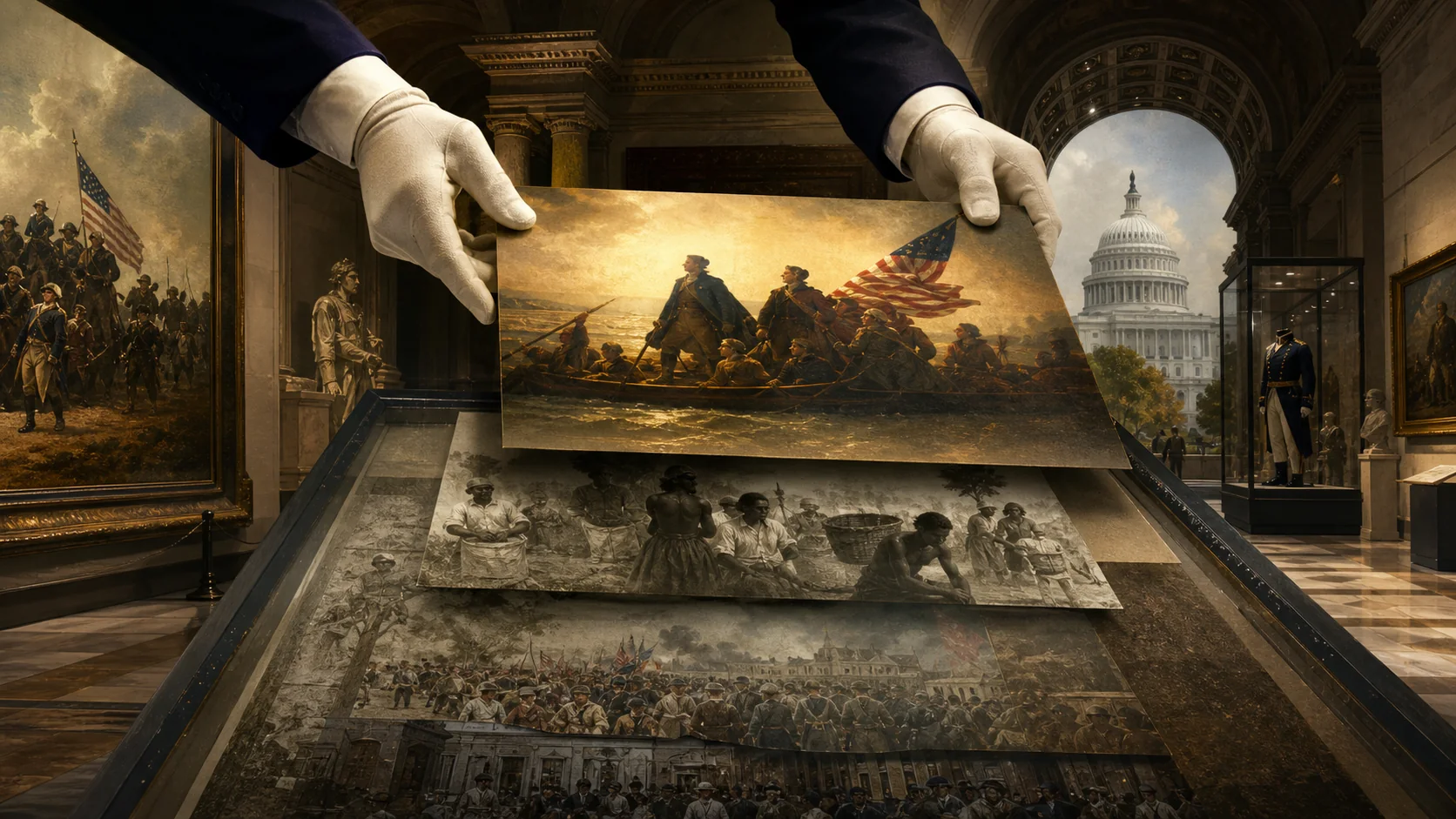
It contains bondage and emancipation, exclusion and expanding citizenship, political failure and self-correction, terrible wars and astonishing sacrifice, hypocrisy and ideals powerful enough to expose that hypocrisy.
A serious museum can hold those truths together.
Too many cultural institutions prefer a simpler morality play: America as defendant, curator as prosecutor, visitor as compulsory juror.
That is not complexity.
It is an ideology with climate control.
Taxpayer Funding Changes the Argument
Progressive curators often talk as though public funding creates a moral obligation to resist public oversight.
Interesting arrangement.
The citizen supplies the money. The expert supplies the worldview. The citizen is then told that questioning the worldview threatens professional independence.
No institution should be micromanaged by whichever politician last won an election. Curators need room to research, disagree, and present evidence honestly.
But professional independence is not hereditary sovereignty.
When an institution accepts massive public funding and claims to represent the nation’s memory, elected officials have a legitimate oversight role. Congress can ask questions. Administrations can review priorities. Citizens can demand balance.
The alternative is a permanent cultural bureaucracy accountable only to itself.
Conservatives have watched that movie before.
The Left Does Not Own Complexity
The most revealing response to Trump’s Smithsonian campaign is the assumption that patriotism and honest history are opposites.
They are not.
Patriotism that cannot face injustice is childish.
History that cannot recognize greatness is cynical.
Americans do not need museums that tell them their country was flawless. They also do not need museums that seem irritated the country survived.
The task is not to replace one ideological script with another.
It is to break the monopoly of the people who decided their script was scholarship and everyone else’s was politics.
Tell the Whole American Story
The Smithsonian should display the chains and the Declaration.
It should show the internment order and the soldiers who liberated camps overseas.
It should describe failures of government and achievements no other civilization had produced at that scale.
It should trust Americans with contradiction rather than steering them toward a fashionable verdict.
The Trump administration can overreach. Curators can overreach. That is why neither side deserves unchecked control.
But one principle should not be controversial.
The Smithsonian belongs to the American people.
Not to the president.
Not to the professors.
And certainly not to a cultural class that mistakes possession of the keys for ownership of the past.

Daniel Mercer is a conservative political writer specializing in elections, government, foreign policy, and the growing power of America’s political and administrative institutions. His work focuses on how decisions made in Washington affect ordinary Americans far beyond the capital. Mercer is particularly interested in executive power, government bureaucracy, media influence, immigration, national security, and the evolution of the Republican Party. At The Dispatch Room, he approaches politics from a pragmatic conservative perspective, separating political theater from the decisions and institutions that actually shape public policy.
Discussion
Loading discussion…