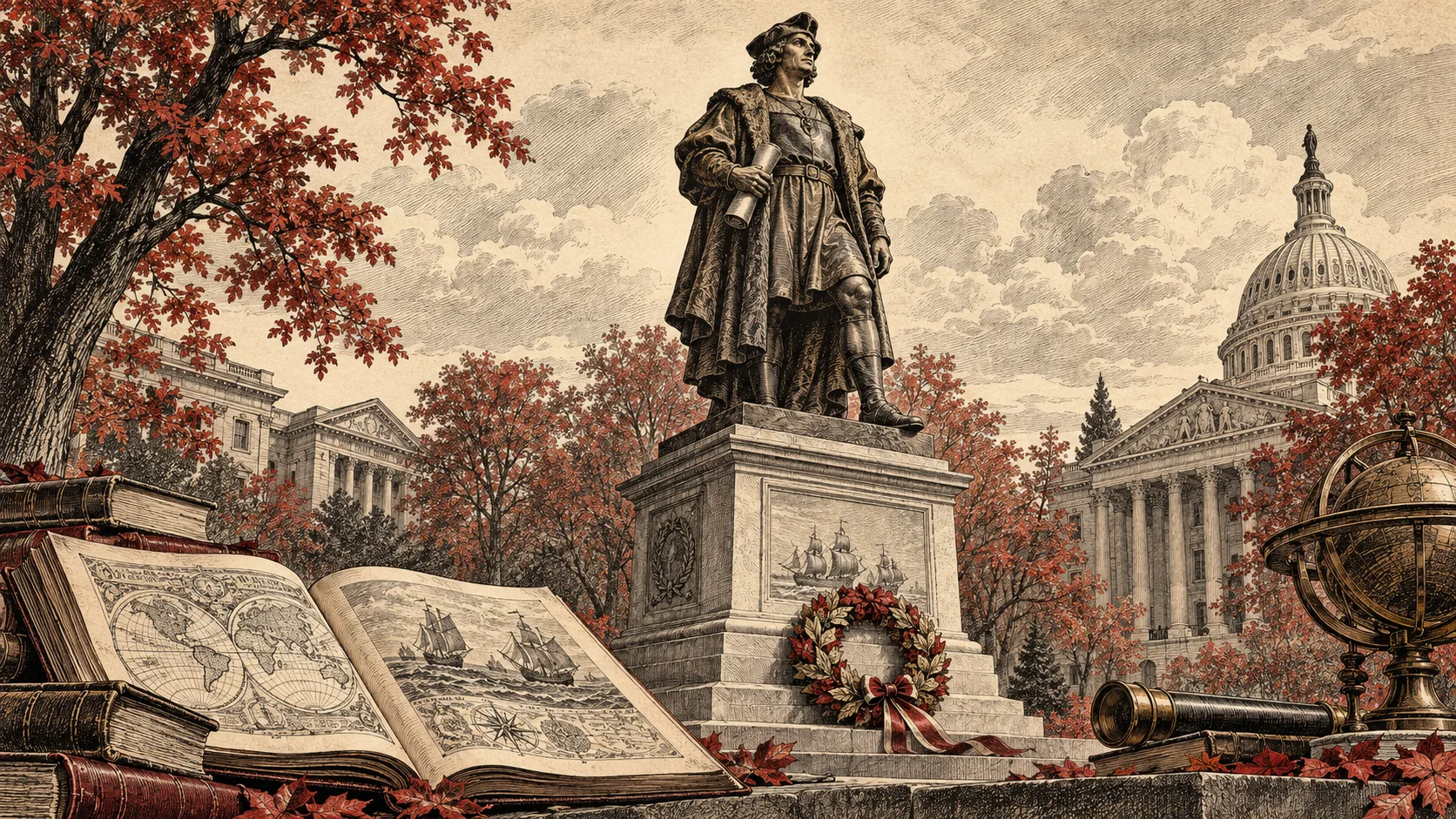
The renewed monument dispute calls for fuller history and genuine public debate—not an assumption that removal is progress.
A city should be capable of adding to its public memory without first hauling part of it away. The argument over Syracuse's Columbus monument deserves more than the familiar choice between treating a statue as sacred and treating its removal as proof of progress.
WRVO reported that supporters and opponents held separate observances at Columbus Circle on October 12. The Columbus Monument Corporation marked the monument's anniversary with a wreath-laying ceremony. Opponents held an Indigenous Peoples Day vigil and called for a redesigned public space. Three redesign finalists were selected in September, according to the report.
The disagreement is real, but its terms matter. Defenders regard the monument, given to the city by the local Italian community in 1934, as a piece of their heritage. Opponents object to honoring Columbus because of his role in colonization. Their proposal includes recognition of Italian Americans alongside Indigenous peoples and other communities. It would be unfair to describe every supporter of removal as hostile to Italian heritage.
Still, promising to honor a community after removing the monument it treasures is not the same thing as persuading that community. A redesigned space may look inclusive on paper while leaving longtime participants feeling that their contribution has been edited into something more acceptable to someone else.
The conservative instinct here should be preservation with explanation. Keep the inherited monument, tell visitors why it was erected, and add serious interpretation of the history its original sponsors did not emphasize. Make room for Indigenous history as a subject in its own right, not merely as a footnote to a European explorer.
That would not require declaring Columbus innocent of every criticism. Nor would it require pretending a public statue is equivalent to a history textbook. A monument is an honor, and opponents are entitled to question that honor. But it can also acquire meaning through the generations who gathered around it, raised money for it and understood it as a sign that they belonged.
Those layers should make a city more cautious about removal, not less. Public memory belongs neither exclusively to the people who first commissioned a monument nor automatically to the people currently most determined to replace it.
A credible process would put practical alternatives before residents: preservation with new interpretation, additional memorials, or relocation with a clearly identified destination and an explanation of what would be lost. Officials should explain costs, responsibilities and selection criteria. Consultation should be an opportunity to influence the outcome, not a ceremony held after the meaningful choices have already been made.
There is room for disagreement about which option ultimately serves Syracuse. What should be rejected is the assumption that keeping a monument means endorsing every act of its subject, or that changing a square necessarily makes the people who inherit it wiser.
My preference is to keep the statue and broaden the story around it. A confident community can confront uncomfortable history while preserving the evidence of how earlier generations understood themselves. It should not need an empty pedestal to prove that it has learned something.

Claire Whitmore is a conservative writer covering culture, family, education, media, and the rapidly changing expectations placed on women in modern America. Her work examines the intersection between politics and everyday life, particularly debates surrounding motherhood, relationships, career expectations, schools, and popular culture. Whitmore is skeptical of political movements that treat traditional choices as inherently outdated and argues that genuine freedom requires allowing women to define success for themselves. At The Dispatch Room, she brings a measured but unapologetically conservative perspective to some of the country’s most contentious cultural debates.
Discussion
Loading discussion…