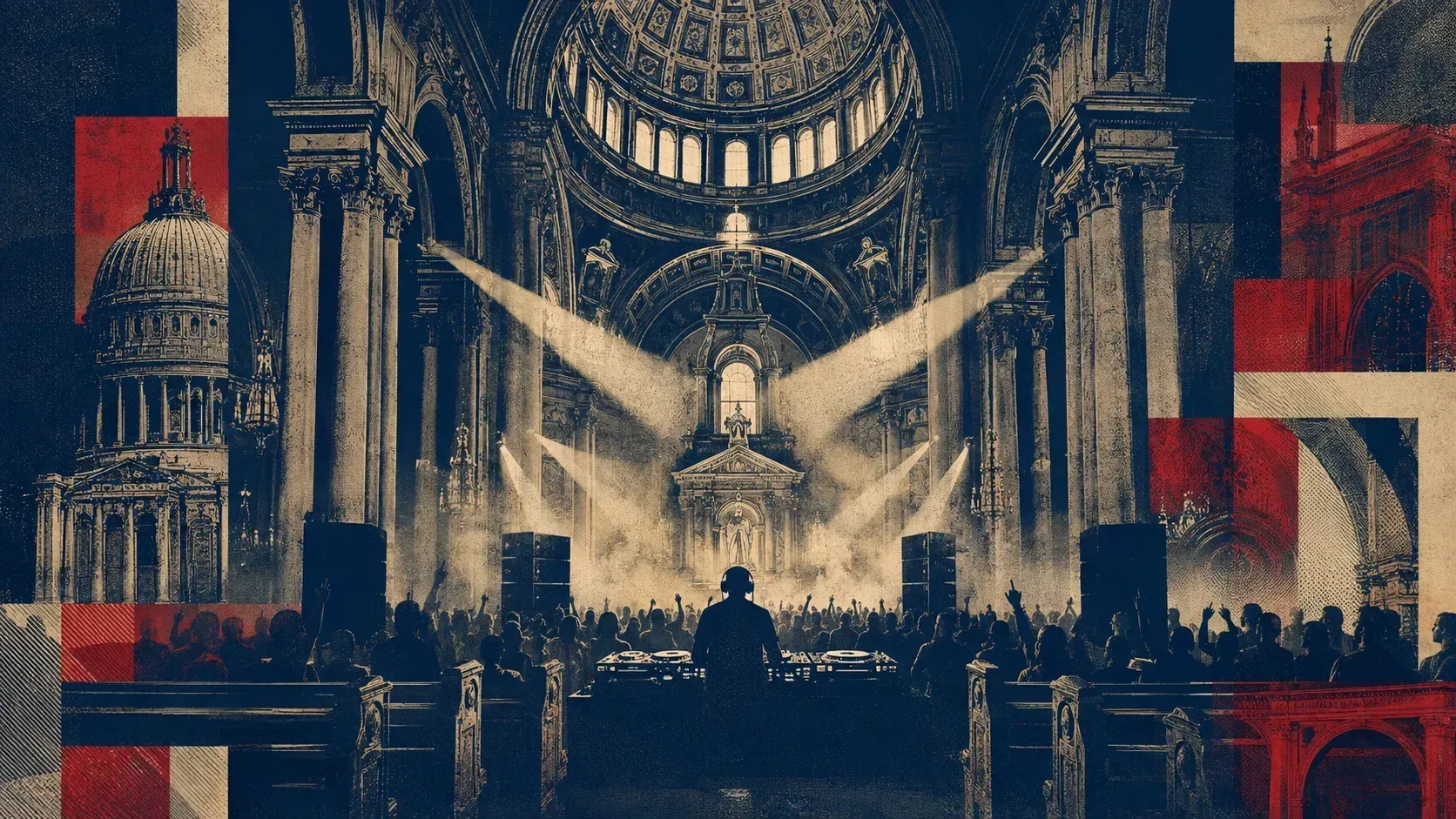
London’s most recognizable cathedral has made Fabric its exclusive contemporary-music partner through 2030. The arrangement raises a question institutions keep avoiding: what is a sacred place for?
A civilization reveals what it values not only by what it builds, but by what it refuses to turn into a venue.
St. Paul’s Cathedral announced on September 1 that it had entered a four-year partnership with Fabric, the famous London nightclub. From 2026 through 2030, Fabric will serve as the cathedral’s exclusive partner for contemporary music events, placing a club promoter inside one of the most historically and spiritually significant Christian buildings in the English-speaking world.
The immediate temptation is to exaggerate. Not every concert is a rave, a DJ is not automatically an agent of desecration, and churches have hosted music for centuries. St. Paul’s itself has long been a setting for performances, national remembrance and public gatherings as well as worship.
Nevertheless, the partnership deserves scrutiny because “Can this attract a crowd?” has quietly replaced “Does this belong here?” as the governing question of many cultural institutions.
A cathedral is not merely an old building with excellent acoustics. Its scale, architecture and beauty were created to direct attention upward, away from ordinary appetite and toward God. Even visitors who do not share the faith understand that they are entering a place set apart from the commercial world outside.
That distinction is precisely what makes St. Paul’s attractive to event organizers. A nightclub can manufacture darkness, sound and spectacle, but it cannot manufacture centuries of meaning. The cathedral supplies the awe; the promoter supplies the equipment; and an institution worried about attendance congratulates itself for being relevant.
This is the familiar bargain made by churches across the West. Empty pews and declining influence produce institutional anxiety. Leaders decide that the answer is to make sacred spaces less demanding, less distinct and more compatible with the habits people already have. Worship becomes performance, doctrine becomes branding and outreach becomes whatever fills the room.
The strategy misunderstands the problem. People do not need a cathedral to imitate a nightclub because London already has nightclubs, including Fabric. What the city cannot easily replace is a place that resists the logic of entertainment altogether.
Supporters of the agreement will argue that contemporary events introduce new audiences to a historic building. That may be true. Some attendees could admire the architecture, become curious about its history or return for a service. Institutions should not fear everyone who arrives by an unconventional door.
But opening a door is different from surrendering the definition of the room. If the experience is organized principally around sound systems, performers, ticketing and spectacle, the cathedral risks becoming an unusually ornate backdrop for an event whose meaning comes from somewhere else.
The concern is not musical style. Christianity has absorbed and transformed artistic forms across cultures for two thousand years. The question is whether art serves the sacred character of the building or borrows that character as production value.
Modern administrators dislike that distinction because it requires judgment. It is easier to celebrate “partnership,” “access” and “engagement” than to say certain uses are worthy of a cathedral and others are not. Inclusivity becomes a convenient way to avoid institutional confidence.
The result is a peculiar form of cultural surrender. Christian institutions are told they must become more secular to remain visible, while secular brands eagerly borrow Christian architecture because their own spaces cannot provide the same gravity. The church doubts the value of what it possesses at the exact moment commercial culture recognizes that value and wants to rent it.
St. Paul’s is not a museum piece, and preserving it does not require silence every hour of the day. A living cathedral should contain music, argument, charity, mourning, celebration and public life. What it needs most, however, is a clear hierarchy of purpose. Everything inside should answer to the fact that it is first a house of worship.
Once that priority becomes negotiable, almost any proposal can be justified by attendance figures and publicity. The building remains magnificent, the dome still dominates the skyline and the institution continues issuing statements. Yet the boundary separating sanctuary from spectacle grows thinner each time.
The question is not whether Fabric can put on an impressive event inside St. Paul’s. Of course it can. The question is why one of the world’s great cathedrals believes becoming a nightclub venue is necessary to prove that it is alive.

Daniel Mercer is a conservative political writer specializing in elections, government, foreign policy, and the growing power of America’s political and administrative institutions. His work focuses on how decisions made in Washington affect ordinary Americans far beyond the capital. Mercer is particularly interested in executive power, government bureaucracy, media influence, immigration, national security, and the evolution of the Republican Party. At The Dispatch Room, he approaches politics from a pragmatic conservative perspective, separating political theater from the decisions and institutions that actually shape public policy.
Discussion
Loading discussion…