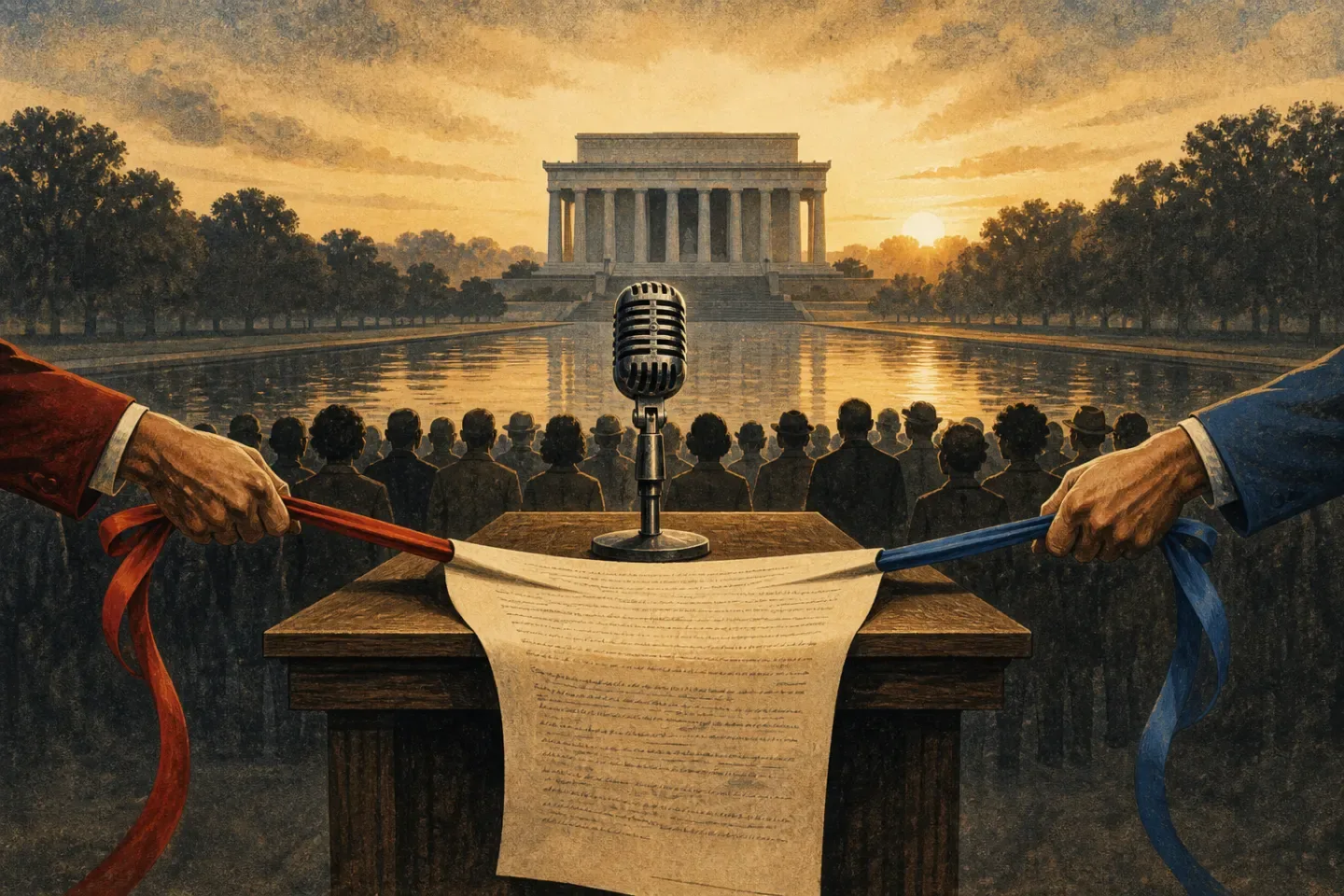
Sixty-three years after the March on Washington, the Left and Right still compete to inherit King’s moral authority. Neither side should be allowed to keep only the sentences it finds convenient.
Every American political faction wants Martin Luther King Jr. standing behind it. The Left invokes him to bless the latest expansion of the civil-rights bureaucracy. The Right repeats his appeal to judge people by character rather than color. Both sides reach for his moral authority because, sixty-three years after the March on Washington, King remains more trusted than the politicians borrowing his words.
That makes today’s anniversary more than a history lesson. Thousands are gathering at the Lincoln Memorial for a “Defend the Vote” march organized by Al Sharpton’s National Action Network, Martin Luther King III and allied civil-rights groups. The event’s platform joins voting rights, economic justice and the defense of diversity, equity and inclusion under King’s banner.
The organizers have every right to make that argument. They do not have an exclusive deed to the dream.
King was not a party spokesman waiting for modern activists to finish his press release. He was a Christian minister, an integrationist, a critic of American injustice and an advocate of nonviolent moral confrontation. His politics cannot be reduced to one famous sentence. But neither can that sentence be treated as an embarrassing relic whenever equal treatment conflicts with today’s progressive program.
The real question is not who can quote King. It is who still accepts the standard he placed before the country.
The Left Replaced Equality With Permanent Management
The civil-rights movement demanded that America honor principles already written into its founding documents. Citizenship had to mean citizenship. Equal protection had to apply to Black Americans in practice rather than merely exist on paper. Government could not tolerate a racial caste system and then congratulate itself for neutrality.
That moral clarity helped tear down legal segregation. It also pointed toward a country in which race would lose its power to assign a person’s place, rights and destiny.
Modern progressivism increasingly moves in the opposite direction. Diversity programs sort applicants by race. Equity offices assign political meaning to skin color. Institutions train Americans to approach one another as representatives of favored or disfavored groups before they meet as individuals. The bureaucracy claims it is dismantling racial categories while making those categories central to admissions, hiring, contracting and public life.
This is presented as the inevitable continuation of King’s work. It looks more like an indefinite postponement of his destination.
A remedy that can never declare success eventually becomes a permanent governing system. Every disparity becomes proof that more racial administration is required. Every demand for neutral rules becomes evidence of hidden prejudice. The country is told it must remain organized by race until the people who benefit from organizing it that way decide the work is finished.
They never will.
Conservatives Should Stop Turning King Into a Mascot
The Right has its own selective memory. Conservatives love the language of character because it expresses a principle we rightly defend: Americans should not receive guilt, innocence, opportunity or punishment according to ancestry.
But repeating that principle is easier than applying it consistently.
King did not believe racial injustice would disappear if polite people simply stopped mentioning it. He challenged discriminatory laws, unequal access to the ballot, economic exclusion and government institutions that failed to protect citizens. He understood that formally neutral language can coexist with unequal enforcement.
Conservatives should therefore resist the temptation to treat every concern about voting access as a scam, every civil-rights protest as a grievance business or every discussion of historic injustice as an attack on America. A commitment to equal citizenship requires examining whether the rules are fair, knowable and applied to everyone—not merely declaring them neutral from a distance.
Election integrity and voting access are not enemies. A serious country should be capable of protecting both. Secure identification, accurate voter rolls and transparent procedures can coexist with reasonable access for eligible citizens. The argument should turn on evidence and workable rules, not on which party expects to gain votes.
If conservatives want to claim King’s universalism, we must accept the responsibility that comes with it. Equal treatment is not a slogan reserved for fighting DEI. It is a standard for government itself.
A Dream Is Not a Party Platform
Today’s march will place King’s legacy behind a modern progressive coalition. Speakers will argue that new election rules, court decisions and opposition to DEI represent a retreat from civil rights. Some of those claims deserve examination. Others use the moral emergency of the past to shield present-day policies from ordinary debate.
That is precisely why no movement should be permitted to monopolize King.
Black Americans are not obligated to accept racial preferences because activists call them civil rights. We are not required to treat the Democratic Party as the permanent custodian of Black political interests. We can defend equal access to the ballot while rejecting the idea that every election rule is racist. We can remember segregation honestly without building a new politics in which race once again determines what a person is expected to believe.
King’s dream was demanding because it denied every faction an easy escape. The country could not invoke liberty while tolerating segregation. Activists could not preach brotherhood while surrendering to hatred. Citizens could not demand justice for themselves while abandoning the idea of a shared American future.
That standard still exposes hypocrisy on both sides.
The Left cannot celebrate King while turning racial classification into a permanent administrative creed. The Right cannot quote King while ignoring unequal treatment when acknowledging it becomes politically inconvenient. Neither side honors him by converting a moral vision into partisan property.
Martin Luther King Jr. does not belong to conservatives or progressives. His words belong to a country still deciding whether equal citizenship is a principle or merely a weapon.
The dream survives only if nobody gets to own it.

Daniel Mercer is a conservative political writer specializing in elections, government, foreign policy, and the growing power of America’s political and administrative institutions. His work focuses on how decisions made in Washington affect ordinary Americans far beyond the capital. Mercer is particularly interested in executive power, government bureaucracy, media influence, immigration, national security, and the evolution of the Republican Party. At The Dispatch Room, he approaches politics from a pragmatic conservative perspective, separating political theater from the decisions and institutions that actually shape public policy.
Discussion
Loading discussion…