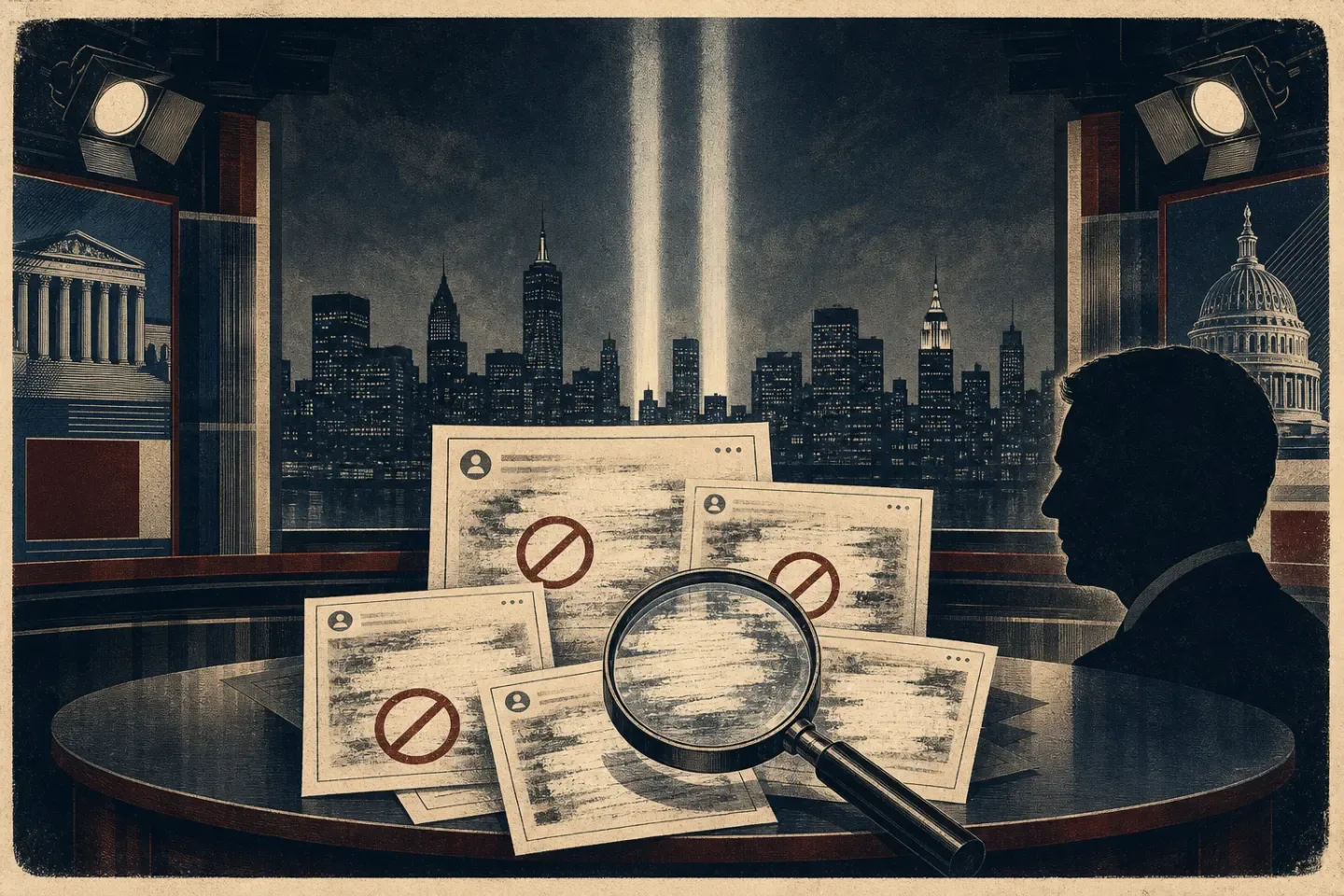
A Senate candidate’s record is fair game. Treating ordinary scrutiny as prejudice is an attempt to make biography off-limits.
CBS News examined old social-media posts from Abdul El-Sayed, the Democratic nominee for the United States Senate in Michigan. The posts had been deleted. They concerned September 11, the wars that followed and the COVID death toll. CBS verified them, described their context and included a response from his campaign.
For this act of journalism, the network was accused of Islamophobia.
That reaction tells us more about the modern progressive understanding of the press than the original story ever could. Reporting is celebrated when it exposes a Republican's past and condemned as bigotry when it complicates the preferred biography of a Democratic candidate. The standard is not whether the information is accurate or relevant. The standard is whether publication helps the correct side.
El-Sayed's posts are not a confession to some hidden crime. In one, written during the pandemic, he compared the growing COVID death toll with the nearly 3,000 people killed on September 11 and argued for a national mobilization against disease and poverty. In another, he mourned the Americans killed in the attacks before contrasting their deaths with the suffering caused by the wars that followed.
Voters can read those ideas and reach different conclusions. Some will find them reasonable. Others will see a familiar progressive habit of placing an immediate qualification after an expression of national mourning. The role of a news organization is to put the material in front of the public, not to decide that voters are too prejudiced to encounter it.
Scrutiny Is Not a Slur
El-Sayed's campaign says he unequivocally condemns terrorism and the September 11 attacks. It also says the deletion was part of a broader removal of posts predating July 2023, intended to prevent old statements from being presented without context. That explanation belongs in the story, and CBS included it.
The explanation does not make the posts off-limits. El-Sayed is seeking a Senate seat in a nationally important election. His political history, public associations and own words are legitimate subjects for reporting. His religion neither increases nor decreases the amount of scrutiny he should receive.
Calling the coverage Islamophobic does something more cynical than defend a candidate. It implies that normal questions become illegitimate when asked of a Muslim politician. That is not equality. It is a demand for a protective barrier around one candidate's record, enforced by accusing journalists of moral contamination whenever they approach it.
CBS can be criticized for its framing. Any headline connecting a Muslim candidate and September 11 demands particular care because cheap insinuations are real and have a long history. But caution is not silence, and sensitivity cannot become immunity.
The relevant facts remain straightforward: El-Sayed wrote the posts, they were later deleted, and they illuminate how he talks about terrorism, war and American power. CBS reported those facts while presenting his campaign's answer. Readers are capable of deciding what weight to give them.
The Press Cannot Work Under an Ideological Veto
This episode arrives as El-Sayed is already trying to define the boundaries of his political coalition. He recently distanced himself from Hasan Piker after the streamer made comments about pro-Israel rhetoric and potential backlash against American Jews. El-Sayed also apologized for remarks following an attack on a Michigan synagogue, saying that his effort to provide context was made at the wrong time and caused hurt.
None of that proves that El-Sayed shares every belief of every person around him. It does establish why reporters would examine his language, associations and judgment. A Senate campaign is not a private therapy session. Candidates do not get to present only the portions of their history that flatter the current message.
Progressives once insisted that journalism must interrogate power. Apparently, that principle now comes with an exemption for candidates whose identities make scrutiny politically uncomfortable. Under this arrangement, the press may investigate, but only after activists approve the premise, tone, headline and likely electoral effect.
That is not journalism. It is campaign communications with better lighting.
El-Sayed deserves to be quoted accurately. He deserves the opportunity to explain himself, and attacks based solely on his faith should be rejected without hesitation. He does not deserve a different standard from every other candidate for federal office.
CBS did not accuse him of responsibility for September 11. It reported what he wrote about the event, what he later removed and how those words fit into a contested Senate campaign. The furious response is an attempt to make that distinction disappear.
If the posts are harmless, let voters see them and conclude that they are harmless. If the framing is unfair, rebut it with evidence. But demanding that the subject never be raised because the candidate is Muslim asks the public to confuse equal treatment with special protection.
The press should refuse that bargain. So should voters.
Marcus Bennett is a conservative commentator focused on crime, education, economic opportunity, urban policy, and American culture. Raised in a working-class community outside Atlanta, Bennett developed his politics around the belief that public policy should be judged by results rather than intentions. His columns frequently examine failing institutions, public safety, family stability, educational reform, and the political assumptions surrounding Black Americans. Bennett brings a skeptical, data-driven approach to political arguments and has little patience for ideological explanations that fail to match conditions on the ground.
Discussion
Loading discussion…