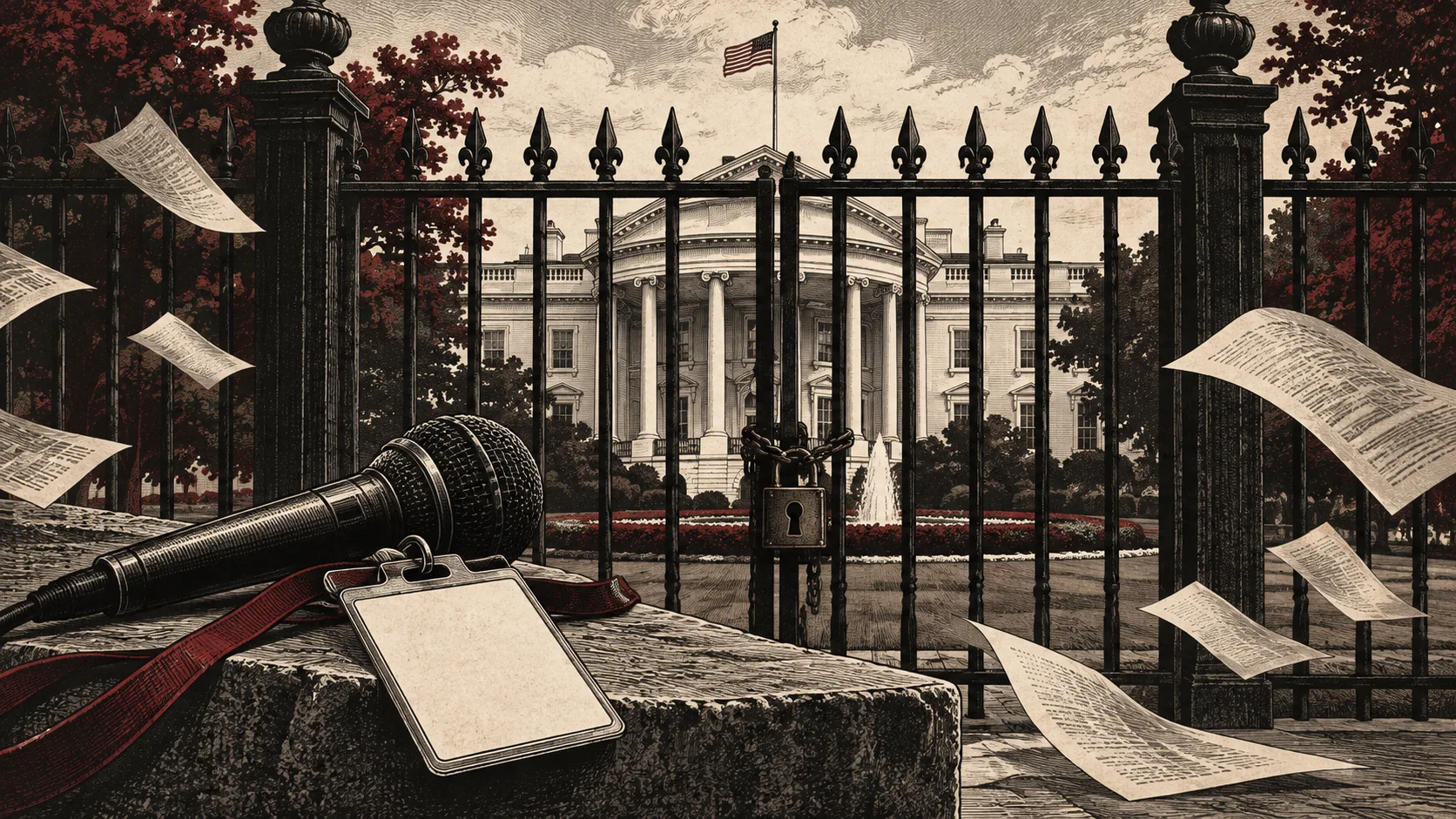
The White House access fight tests whether conservatives want limits on government power even when the excluded outlets are ones they distrust.
You do not have to admire CNN to recognize a bad precedent. Conservatives can challenge a network’s framing, demand corrections and refuse to watch without endorsing the idea that a president should decide which news organizations may cover him based on whether he likes their reporting.
That distinction is at the center of the latest White House media fight. CNN, MS NOW and Politico sued the Trump administration on September 21 after being excluded from White House grounds. According to Reuters, they are seeking a temporary restraining order, with a hearing scheduled for Wednesday. Their constitutional claims are allegations before a court, not a ruling already handed down.
Trump has defended the exclusion as a response to what he calls false reporting. The White House told Reuters that the outlets can continue reporting from outside. Those arguments explain the administration’s position, but they do not answer the deeper question: should government access turn on the president’s assessment of a newsroom’s coverage?
The test is who gets the power next
Conservatives have good reason to think carefully before endorsing discretionary government power over speech. An authority that looks satisfying when used against an irritating network will look very different when another administration applies it to conservative reporters.
Imagine a Democratic president announcing that an outlet’s coverage of immigration or crime is too misleading to deserve access. Would conservatives accept the reassurance that its reporters can still publish from the sidewalk? Or would they ask why the official being scrutinized gets to determine which scrutiny qualifies?
That is not an argument that every reporter has an unlimited right to enter every room. Security, space and orderly proceedings require rules. The important distinction is between neutral standards that can be explained and consistently enforced, and exclusion justified by hostility to coverage.
Nor does defending access require accepting the media’s self-description. News organizations should face hard questions about accuracy, selective emphasis and the boundary between reporting and commentary. Their appeal to press freedom does not make every editorial decision wise or every accusation fair.
But those criticisms should be made with evidence. Publish the disputed claim, show what is wrong with it, demand a correction and let the public judge the response. That is a stronger answer than turning an argument over journalism into an argument over who controls the gate.
Access is not an endorsement
The dispute has already complicated television coverage. Reuters reported that the major networks suspended presidential pool coverage after CNN could not provide the scheduled feed. The pool normally shares footage among participating organizations. Its breakdown demonstrates how a fight aimed at particular outlets can affect the broader flow of information.
There is nothing inherently conservative about leaving audiences more dependent on material selected by the government. An administration is entitled to make its case forcefully; it should also expect journalists to ask questions it would rather not answer.
The court will assess the legal claims. The political principle should be easier to state: government power needs limits even when the people inconvenienced by those limits are on our side.
Conservatives should keep criticizing weak journalism. They should also resist a precedent that lets officeholders decide which critics are legitimate enough to remain in the room. A free press is valuable precisely because neither politicians nor audiences have to like everything it produces.

Claire Whitmore is a conservative writer covering culture, family, education, media, and the rapidly changing expectations placed on women in modern America. Her work examines the intersection between politics and everyday life, particularly debates surrounding motherhood, relationships, career expectations, schools, and popular culture. Whitmore is skeptical of political movements that treat traditional choices as inherently outdated and argues that genuine freedom requires allowing women to define success for themselves. At The Dispatch Room, she brings a measured but unapologetically conservative perspective to some of the country’s most contentious cultural debates.
Discussion
Loading discussion…