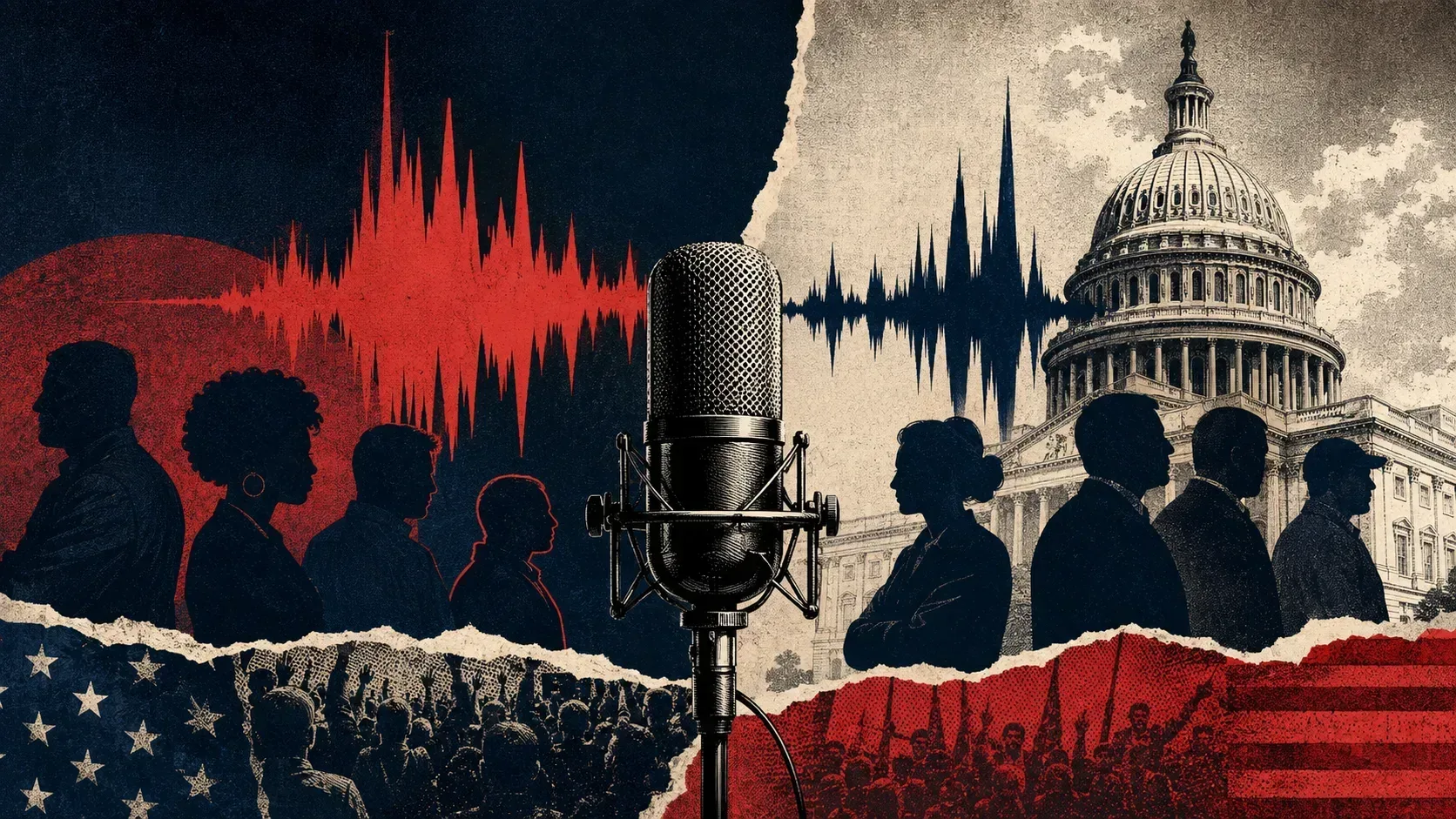
Rula Jebreal’s attack on Hakeem Jeffries exposed a political culture that treats bigotry as intolerable in theory and negotiable when the target becomes inconvenient.
The modern left has built an enormous moral vocabulary around racism. It has seminars, consultants, reading lists, corporate departments and an endless supply of public scoldings. Yet when one of its own activists reaches for an unmistakably racist insult, the first instinct is often not moral clarity but frantic context.
That instinct was tested this week when journalist Rula Jebreal appeared on Wajahat Ali’s podcast and attacked House Democratic leader Hakeem Jeffries over his support for Israel. Jebreal called Jeffries, a Black man, a “bought and paid by AIPAC monkey” and an “errand boy.”
Ali immediately recognized the problem and stopped to address the racial meaning of the word. Jebreal insisted that she had not meant it with racial animosity and tried to invoke the familiar image of three monkeys who see, hear and speak no evil. The explanation did not rescue the remark because the offense was not hidden in some obscure historical reference. It was sitting in plain sight.
The Congressional Black Caucus said there was no non-racist way to direct that language at a Black man. Democratic representatives including Joe Neguse and Ritchie Torres condemned it, and Jebreal later issued what she called an unconditional apology.
The apology was necessary, but the episode matters for a reason larger than one ugly sentence. It revealed what happens when a political movement trains its members to believe that righteousness depends less on what they say than on whom they are attacking.
Jeffries has become a target of the activist left because he supports Israel, resists parts of its socialist agenda and represents the institutional Democratic Party. In that political environment, an opponent can stop being a person and become a symbol: a servant of donors, an obstacle to liberation or a traitor to the movement. Once that transformation occurs, activists begin granting themselves rhetorical permissions they would never extend to their enemies.
That is how people who spend their careers policing language can suddenly plead for nuance after deploying language they would instantly identify as racist if it came from a Republican.
The point is not that every progressive endorsed Jebreal’s words. They did not. Ali challenged the remark during the interview, the Congressional Black Caucus rejected it, and several Democrats spoke plainly. Their response deserves acknowledgment precisely because consistent standards have become so scarce.
The revealing part is that the insult emerged naturally from a media ecosystem that treats moral accusation as a substitute for persuasion. Anyone who disagrees is not merely wrong; he is bought, captured, complicit or evil. That style of politics creates an arms race in which every participant has to sound more furious and morally certain than the last. Eventually somebody says what the movement claims nobody should ever say.
Conservatives should resist the cheap temptation to argue that this proves racism belongs exclusively to the left. Racism is a human failure, not a party platform. The stronger argument is that no faction should be allowed to build a moral exemption for itself.
If a conservative commentator had used the same term against Jeffries, there would be no patient seminar about intended metaphors. Networks would cut ties, sponsors would flee and every Republican within reach of a microphone would be ordered to denounce it. The standard would be immediate, absolute and probably permanent.
That same standard should apply here. Political affiliation does not bleach a slur clean, and hostility toward AIPAC does not provide a license to reach for racial degradation. A person can criticize Jeffries, his donors, Israel policy or the Democratic leadership without talking about a Black elected official as though he were someone’s animal or servant.
For years, the progressive press has claimed that impact matters more than intent. Jebreal’s defense suddenly asked the public to reverse that formula and focus on what she says she meant. The contradiction is impossible to miss.
The left did eventually find its racism limit. It simply took one of its own crossing it, on camera, for everyone to discover where the line had been all along.

Naomi Carter is a conservative columnist whose work focuses on women, identity politics, gender, race, media, and the cultural institutions influencing younger Americans. Carter became increasingly skeptical of progressive politics after seeing complex questions of identity reduced to rigid ideological categories. Her writing challenges political orthodoxies on both race and gender while emphasizing individual agency, personal responsibility, free expression, and equal treatment under the law. At The Dispatch Room, Carter frequently examines how political narratives are created, amplified by media and institutions, and ultimately experienced by ordinary people.
Discussion
Loading discussion…