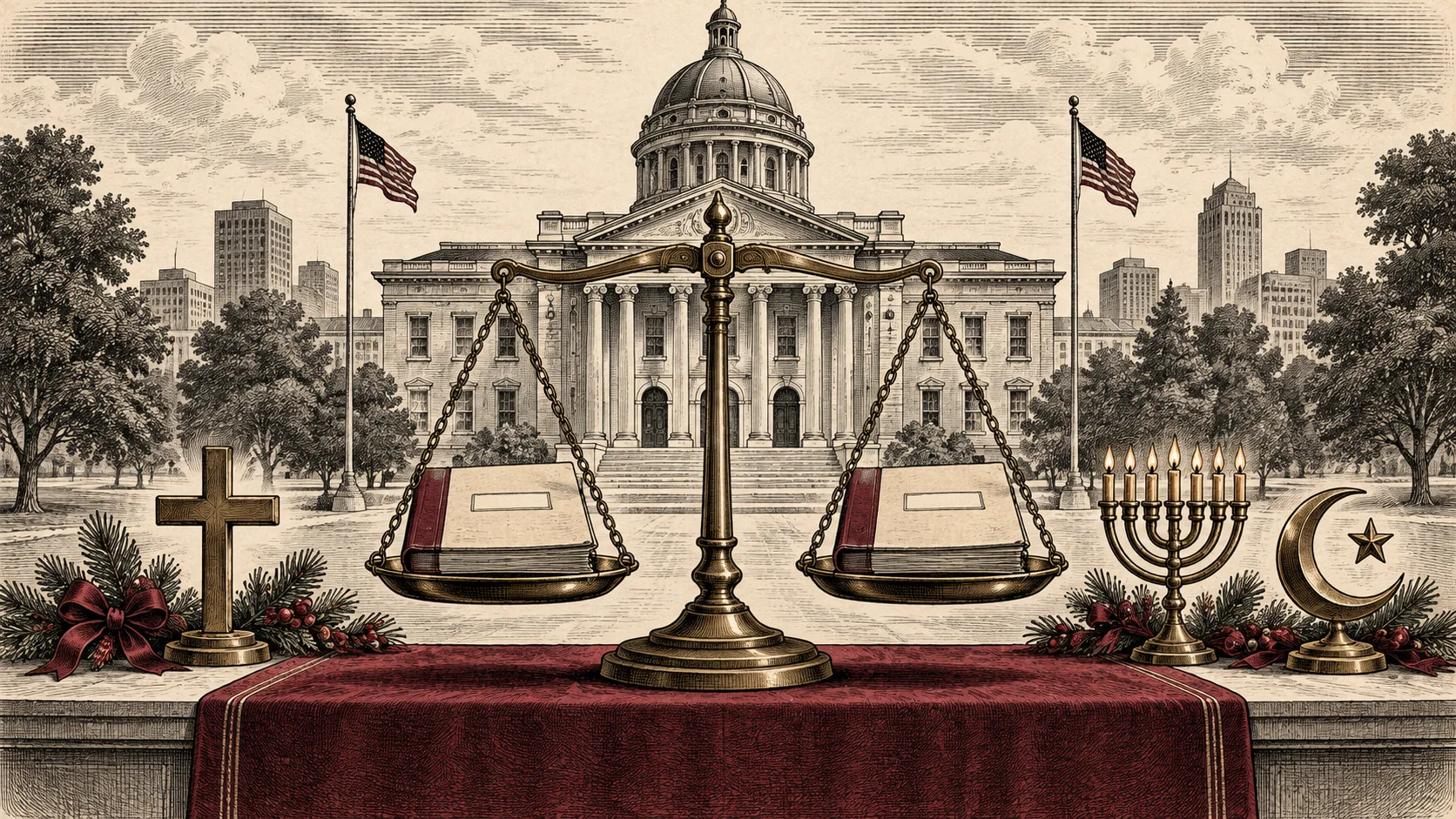
A lawsuit challenges the city’s religious holiday spending. Transparent rules would tell residents more than another promise of inclusion.
A city does not answer a complaint about unequal treatment by announcing that it believes in inclusion. The useful answer is in its rules, its spending and the way it responds when a resident asks an uncomfortable question.
That is the standard Dearborn should face in its dispute over religious holiday displays.
The American Freedom Law Center announced September 17 that it sued the city and Mayor Abdullah Hammoud on behalf of resident Margot Cleveland. The organization alleges that officials used public resources for Ramadan displays while refusing requests for comparable Christian and Jewish recognition. It also alleges retaliation after Cleveland raised the issue. Those are the plaintiff's claims, not established findings of misconduct.
According to the Associated Press's September 19 report, Dearborn responded that it serves residents equitably regardless of faith and that its diversity and welcoming character have made it a target. The city disputed the picture presented by its critics. Nothing in that exchange, by itself, decides the lawsuit.
Show residents the rules
There is a straightforward political response available even while lawyers argue: explain how holiday displays are selected, how requests are considered and what public resources are committed. If different proposals receive different treatment, identify the relevant criteria and show that they are applied consistently.
Residents should not need to guess whether access to civic recognition depends on having the right allies at city hall. Equally, a government cannot reasonably promise an identical event for every belief, observance or request. Budgets and practical limits exist. That is why a clear policy matters more than a string of reassuring adjectives.
A conservative critique should keep its target precise. Muslim residents celebrating Ramadan are not the problem. They have the same right to practice their religion and participate in community life as anyone else. The question concerns government decisions made with public resources, not whether a neighbor's faith belongs in America.
That distinction also makes the argument stronger. Equal treatment is a principle a person can apply in any city, including one where Christians hold the political majority. It does not become less important when defending an unpopular minority, or more persuasive when delivered as an attack on an entire community.
Inclusion has to survive disagreement
Public officials should expect residents to challenge their priorities. A complaint can be partisan, irritating or badly timed without making the underlying policy question disappear. The responsibility of government is to explain its decisions, not demand that everyone first endorse its preferred description of itself.
The court will assess the legal claims. In the meantime, the public can ask for transparent standards without pretending a complaint is a verdict. If the allegations are supported, officials should correct the unequal treatment. If they are not, a clear factual response will serve the city better than an argument over who is entitled to criticize it.
Dearborn says it welcomes everyone. The best way to defend that promise is to make its equal-treatment policy visible enough that residents do not have to take it on faith.

Claire Whitmore is a conservative writer covering culture, family, education, media, and the rapidly changing expectations placed on women in modern America. Her work examines the intersection between politics and everyday life, particularly debates surrounding motherhood, relationships, career expectations, schools, and popular culture. Whitmore is skeptical of political movements that treat traditional choices as inherently outdated and argues that genuine freedom requires allowing women to define success for themselves. At The Dispatch Room, she brings a measured but unapologetically conservative perspective to some of the country’s most contentious cultural debates.
Discussion
Loading discussion…