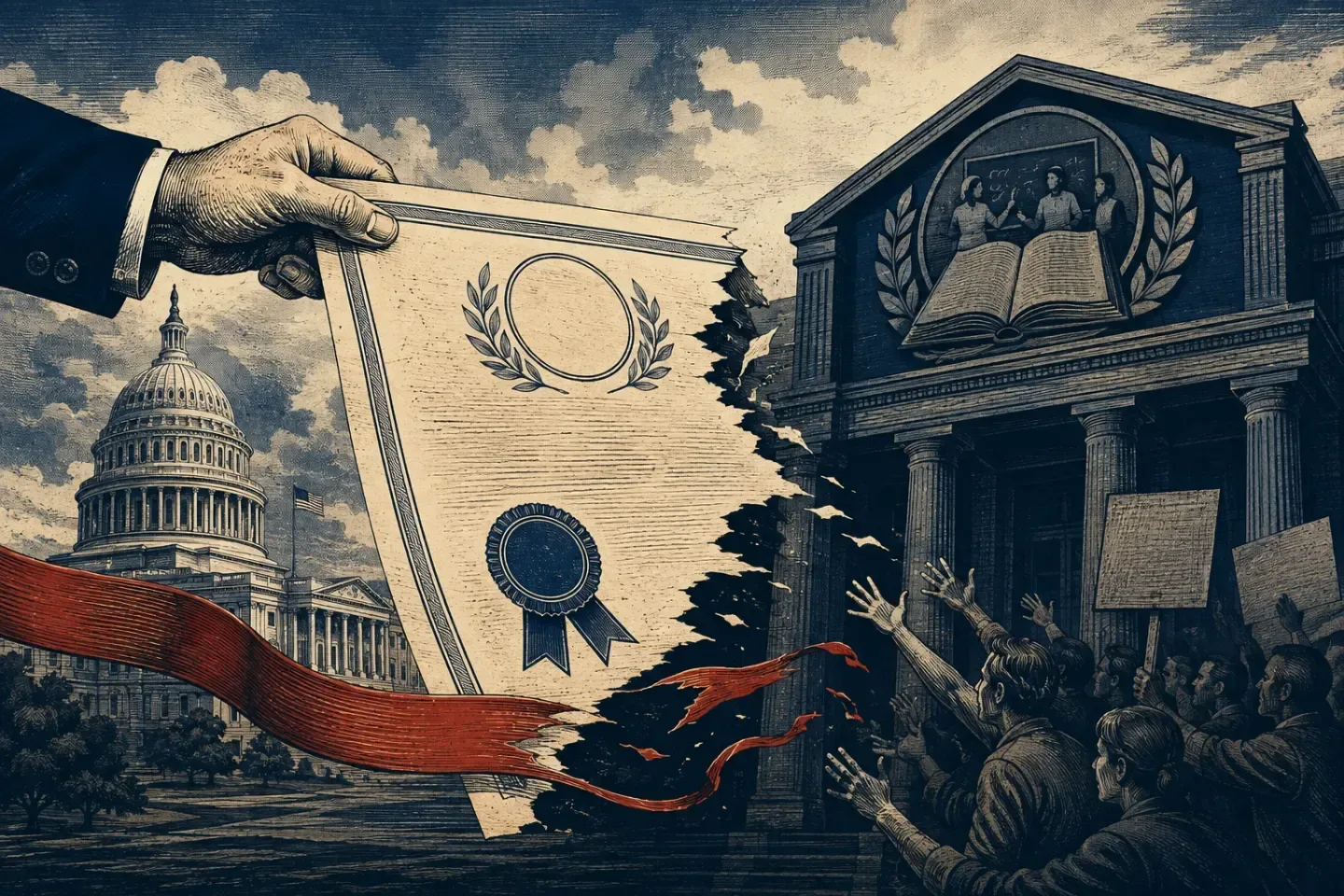
The campaign to repeal the National Education Association’s congressional charter asks a question the union’s defenders would rather avoid: what public purpose does this recognition still serve?
The National Education Association does not conceal its politics. It spends, organizes and speaks as a major progressive institution while claiming to represent the professional interests of American educators. That makes a congressional effort to repeal its federal charter more than symbolic theater.
A federal charter is not the same thing as a federal subsidy, and critics should not pretend otherwise. It does not give the NEA control over public schools or automatically deliver taxpayer money. What it does provide is formal recognition in federal law—a civic badge inherited from a period when Congress routinely chartered prominent national organizations.
Senators Marsha Blackburn and Cynthia Lummis introduced legislation to repeal the NEA’s charter, and the proposal has gained renewed attention as critics point to the union’s ideological agenda. The bill is remarkably simple: remove the chapter of federal law granting that recognition.
The NEA will argue that charter repeal is retaliation for political speech. That argument deserves consideration. Government should not punish private associations merely because officeholders dislike their opinions.
But a charter is not an entitlement to permanent prestige. Congress is also entitled to ask whether an organization still embodies the broad public mission that justified federal recognition in the first place. A union operating as an aggressive participant in partisan politics cannot demand that Americans regard its federal charter as a politically neutral artifact.
The larger problem is the double identity teachers unions have cultivated. In policy debates, they speak as trusted guardians of children and classrooms. During elections and culture-war fights, they behave like disciplined political organizations. They want the moral authority of a profession and the combat power of an interest group, without accepting scrutiny of the contradiction.
Repealing the charter would not silence the NEA. It would not prevent members from organizing, bargaining, spending money or endorsing candidates. The union would retain the same First Amendment rights as every other association. It would simply lose a ceremonial distinction that most political organizations never possessed.
That is why the debate is useful even if repeal never becomes law. It forces Congress to define what a federal charter means. Is it a historical curiosity that no longer signals approval? Is it recognition of continuing public service? Or is it a favor that, once granted, can never be reconsidered?
The NEA is free to become as partisan as its leadership and members desire. The public is equally free to ask why federal law should continue placing a congressional ribbon around that partisanship.

Claire Whitmore is a conservative writer covering culture, family, education, media, and the rapidly changing expectations placed on women in modern America. Her work examines the intersection between politics and everyday life, particularly debates surrounding motherhood, relationships, career expectations, schools, and popular culture. Whitmore is skeptical of political movements that treat traditional choices as inherently outdated and argues that genuine freedom requires allowing women to define success for themselves. At The Dispatch Room, she brings a measured but unapologetically conservative perspective to some of the country’s most contentious cultural debates.
Discussion
Loading discussion…