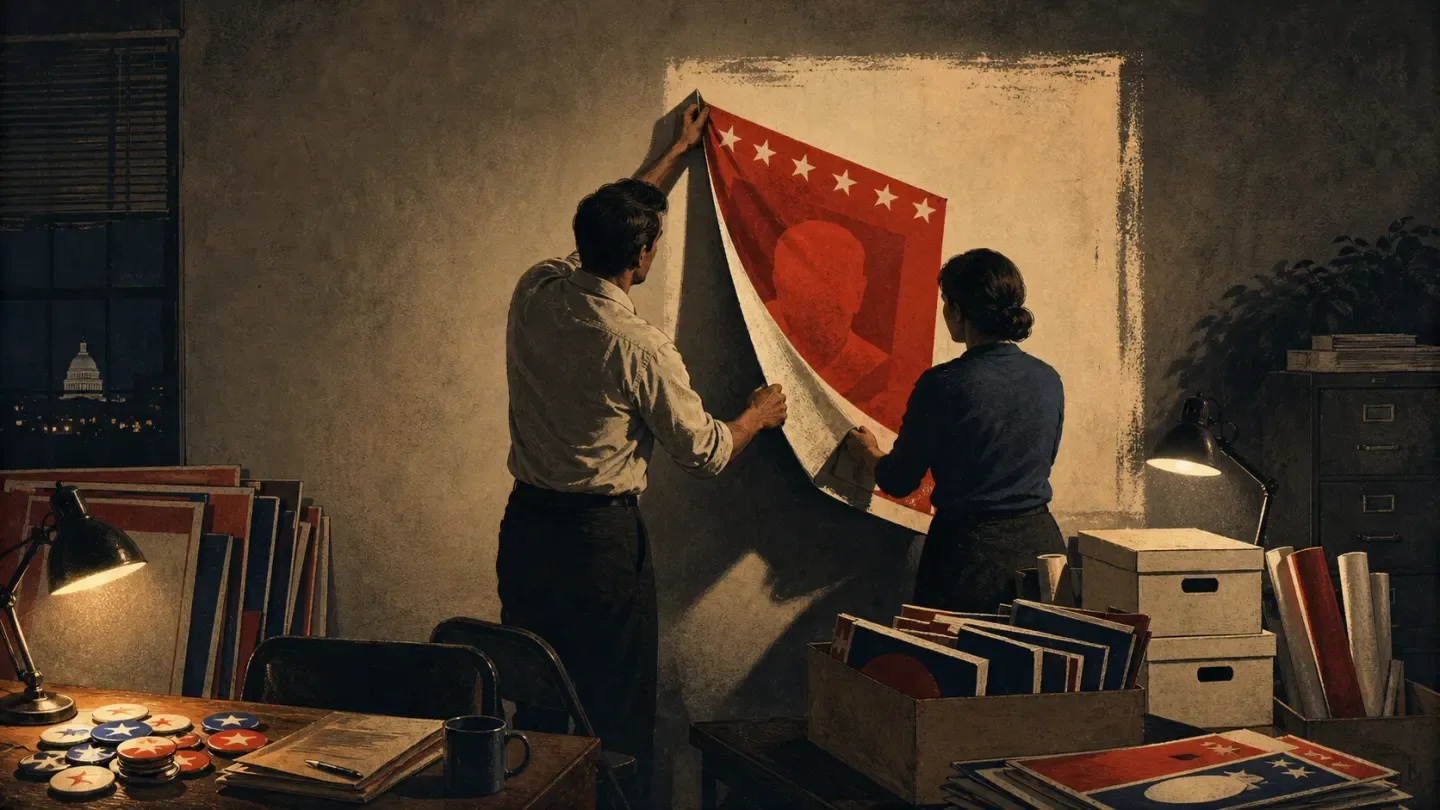
Primary-season loyalty was displayed in bold type. With the general election approaching, some Republican campaigns appear considerably less eager to keep Donald Trump’s name on the page.
Campaign websites are supposed to tell voters what a candidate believes. Sometimes they reveal something else: what a candidate no longer wants voters to remember.
Several Republican nominees who leaned heavily on President Donald Trump during their primaries have reportedly softened or removed that branding as the general election approaches. The edits vary by campaign, but the pattern is familiar. Trump’s endorsement is priceless when Republican voters are choosing a nominee. Once a broader electorate enters the picture, the same endorsement can suddenly become harder to locate.
That is not ideological evolution. It is political housekeeping.
A campaign can change a headline, replace a photograph or rewrite an “about” page in minutes. The underlying calculation is harder to disguise. These candidates wanted primary voters to see them as loyal Trump conservatives. Now they appear to want swing voters to encounter a more carefully edited version of the same candidacy.
The tactic may be understandable. It is not admirable.
Republicans spent years accusing Democrats of hiding unpopular positions behind softer vocabulary. “Defund the police” became “reimagining public safety.” Expansive government spending became “investment.” A border crisis became a “challenge.” Conservatives were right to mock the euphemisms. But that criticism carries a responsibility: Republican candidates should not practice their own version of political camouflage when an endorsement becomes inconvenient.
Voters deserve an honest choice. If a candidate believes Trump’s record and agenda make the country stronger, the candidate should be able to say so in October as clearly as in March. If the association is a liability, voters are entitled to know that too. What they should not receive is one identity for a closed Republican primary and another for the general-election homepage.
The disappearing language also raises a larger question about the Republican coalition. Trump remains the party’s dominant figure, yet some campaigns evidently believe the safest way to win persuadable voters is to borrow his movement’s energy without displaying its name too prominently.
That is a dangerous habit for a party that claims to value plain speaking. A movement cannot remain coherent if its candidates treat their own political identity like seasonal merchandise—displayed when demand is high, packed away when the audience changes.
None of this means every Republican campaign must turn its website into a shrine. Candidates should talk about local concerns, their own records and the issues voters face now. But removing conspicuous pro-Trump material after using it to secure a nomination is different from broadening a message. One expands the case. The other edits the receipt.
Democrats will exploit the inconsistency, and they will not need to invent much. Archived pages, old advertisements and endorsement announcements do not disappear merely because a campaign redesigns its website. The internet remembers what consultants hope suburban voters will forget.
Republican candidates have a straightforward choice. Defend the coalition that carried them through the primary, or explain honestly where they differ from it. Either answer is more respectable than quietly rearranging the digital furniture and hoping nobody notices.
The problem is not that campaigns change emphasis. Every serious campaign does. The problem is asking one group of voters to reward a political identity, then asking the next group to pretend it was never there.
If these candidates ran as Trump conservatives, they should have the courage to remain Trump conservatives when the electorate gets larger. And if they do not, voters should ask why the deletion key became their most important campaign tool.

Claire Whitmore is a conservative writer covering culture, family, education, media, and the rapidly changing expectations placed on women in modern America. Her work examines the intersection between politics and everyday life, particularly debates surrounding motherhood, relationships, career expectations, schools, and popular culture. Whitmore is skeptical of political movements that treat traditional choices as inherently outdated and argues that genuine freedom requires allowing women to define success for themselves. At The Dispatch Room, she brings a measured but unapologetically conservative perspective to some of the country’s most contentious cultural debates.
Discussion
Loading discussion…