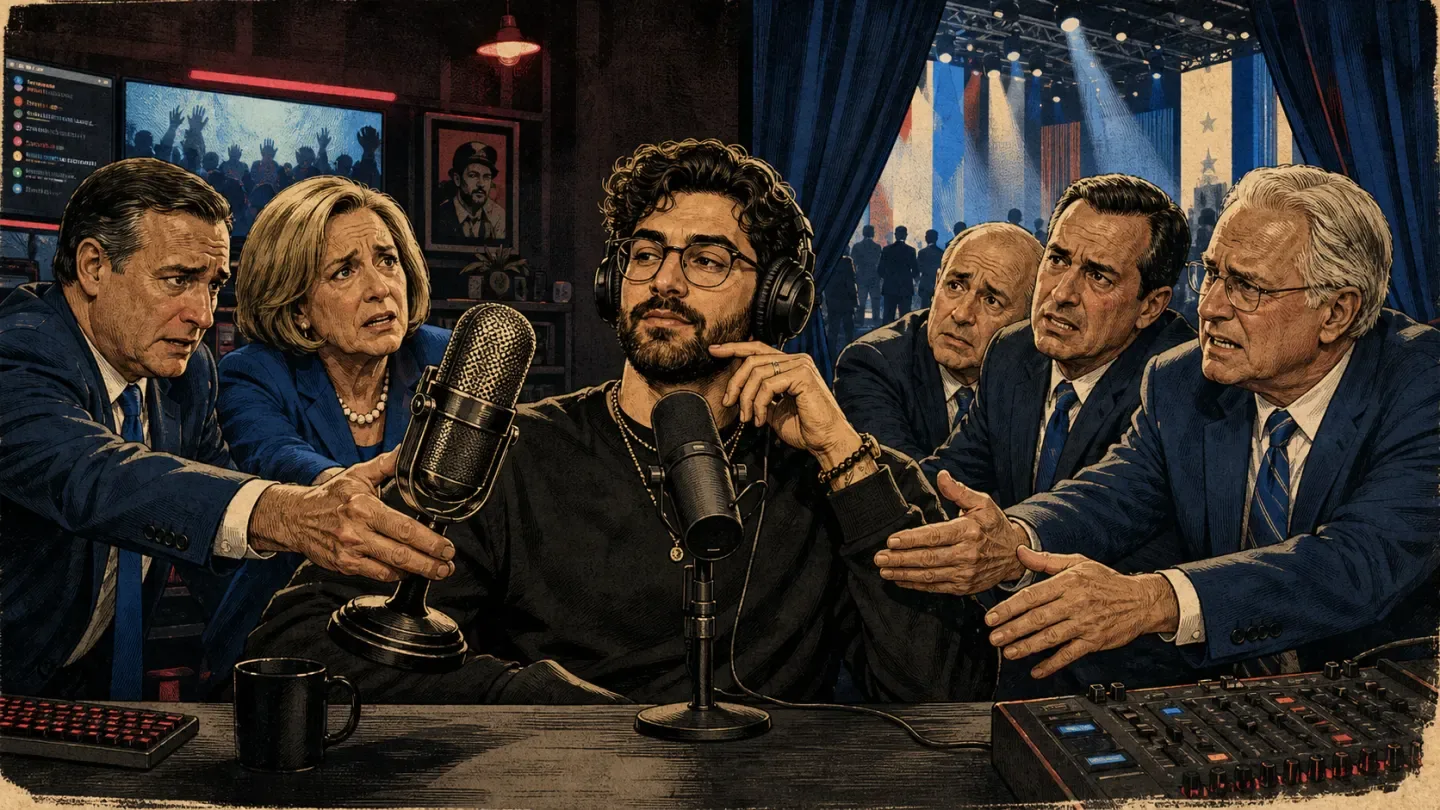
The party spent years searching for an online celebrity who could deliver disaffected young voters. Now its leaders are discovering that renting a radical’s audience means inheriting his politics.
For years, Democratic strategists complained that conservatives possessed something they could not manufacture: an online media ecosystem capable of reaching millions of people without permission from the party, the networks or the campaign consultants.
They watched Donald Trump sit down with podcasters and influencers who spoke to audiences the political establishment barely understood. They studied Joe Rogan’s reach, envied the loyalty of his listeners and began searching for a progressive equivalent.
Hasan Piker appeared to offer an answer. He was combative, fluent in internet culture and followed by an enormous audience of young people who regarded traditional Democratic politics with suspicion. The fact that he routinely attacked the Democratic establishment was not necessarily a disadvantage. Party operatives understood that his hostility made him appear independent—and therefore more valuable.
So Democrats opened the door.
Piker received influencer access at the 2024 Democratic National Convention. He later became a featured presence around progressive campaigns and spoke at a College Democrats gathering. Candidates appeared with him because they wanted his audience, his energy and the appearance of authenticity that no professionally produced campaign advertisement could provide.
The arrangement worked until Piker’s rhetoric became too politically expensive to ignore.
His comments about Israel and American Jews triggered condemnations from prominent Democrats, including House Minority Leader Hakeem Jeffries, Cory Booker and other elected officials. Abdul El-Sayed, the Democratic Senate nominee in Michigan who had campaigned with Piker, distanced himself and said nobody outside his campaign spoke for him.
That retreat may be politically necessary, but Democrats should stop pretending they have been surprised by the product they purchased.
Piker did not conceal his politics while party figures were courting his audience. He has described himself as a socialist, attacked the Democratic establishment from the left and built his reputation through inflammatory commentary. His appeal has always rested partly on saying things conventional politicians would never dare to say.
Democrats were willing to tolerate that record when Piker looked like a shortcut to young voters. Only after his words began threatening competitive races did leading members of the party rediscover the importance of responsible rhetoric.
This is the bargain Democrats keep trying to make with their radical flank. They invite activists into the coalition, borrow their energy and quietly assume that the movement will become disciplined once an election approaches. Instead, the activists recognize that the party needs their voters more than they need the party’s approval.
Piker has never behaved like a loyal Democratic spokesman because he is not one. He has openly criticized the party, threatened to withhold support and presented establishment Democrats as obstacles to the political transformation he wants. His goal is not to strengthen the old Democratic coalition. It is to drag that coalition left—or replace it.
Yet Democratic campaigns continued treating his reach as an asset. They wanted the millions of impressions without the ideological baggage, the youthful rebellion without the consequences and the radical audience without having to defend the radicalism.
Politics does not work that way.
When a party elevates someone because he can reach voters its own leaders cannot, that person gains leverage over the party. He gets to decide what he says, which candidates deserve his support and which controversies everyone else must answer for. The influencer is no longer working for the politicians. The politicians are auditioning for the influencer.
That is why the Piker controversy matters beyond a single livestream or campaign. It reveals a Democratic Party caught between an older establishment that still wants to appear broadly acceptable and a growing activist class that regards compromise as cowardice.
Party leaders can condemn Piker now, but they cannot erase the calculation that placed him near the center of Democratic politics. They believed radicalism could be managed as long as it arrived with enough followers.
Hasan Piker has demonstrated the opposite. The audience was never free, the rhetoric was never incidental, and the radical left was never interested in becoming a decorative wing of the Democratic Party.
Democrats went searching for their own Joe Rogan. What they found was a political faction demanding ownership of the microphone.

Naomi Carter is a conservative columnist whose work focuses on women, identity politics, gender, race, media, and the cultural institutions influencing younger Americans. Carter became increasingly skeptical of progressive politics after seeing complex questions of identity reduced to rigid ideological categories. Her writing challenges political orthodoxies on both race and gender while emphasizing individual agency, personal responsibility, free expression, and equal treatment under the law. At The Dispatch Room, Carter frequently examines how political narratives are created, amplified by media and institutions, and ultimately experienced by ordinary people.
Discussion
Loading discussion…