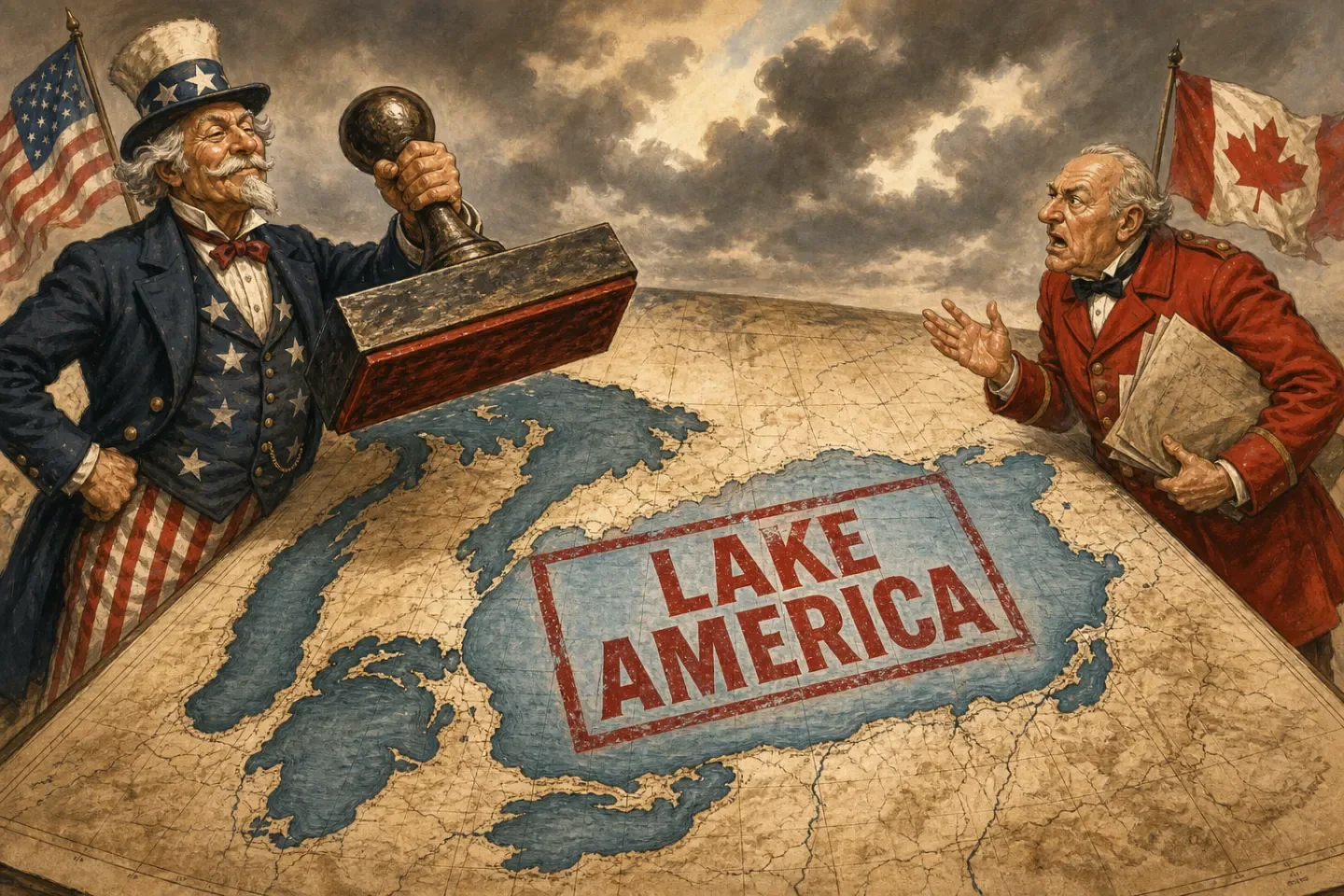
The “Lake America” order is classic Trump: part provocation, part branding exercise and part test of whether his opponents can resist turning a symbolic gesture into a national emergency. They failed almost immediately.
Donald Trump renamed Lake Ontario “Lake America,” and Washington reacted as though he had dispatched the Navy to seize Toronto.
That was always the trap. Trump understands something his opponents still refuse to learn: in the age of social media, a political gesture does not have to change the material world to dominate it. It only needs to be vivid, easy to repeat and outrageous enough that the people who hate it will advertise it for free.
“Lake America” checks every box. It fits on a hat. It produces an instant mental image. It offends exactly the people Trump enjoys offending, while delighting supporters who see national confidence where the professional scolds see diplomatic vandalism.
Then, almost on cue, House Democrats began preparing legislation to reverse the name. An executive order concerning what the United States calls one of the Great Lakes had become another federal emergency. Trump supplied the provocation; Democrats supplied the amplification.
The Outrage Machine Never Learns
For nearly a decade, Trump’s political opponents have insisted that every flourish must be answered with maximum indignation. A joke becomes a constitutional crisis. A nickname becomes an assault on democracy. A sign, statue or place-name becomes a struggle for the nation’s soul.
This is why he keeps doing it. The reaction transforms a piece of political theater into a loyalty test, and the test is designed so that almost everyone plays the assigned role. Trump’s supporters laugh. His critics issue grave statements. Cable panels assemble. By nightfall, millions of Americans who had not thought about Lake Ontario in years are arguing over what to call it.
The outrage is especially rich coming from a political culture that spent years insisting names were deeply consequential. Schools, military bases, streets, mascots and public buildings all had to be renamed because language supposedly shaped reality. Now Trump has adopted the same symbolic politics, wrapped it in red, white and blue, and his opponents suddenly find the whole exercise childish.
Perhaps it is childish. But that concession would require admitting that much of the renaming frenzy was always theater dressed as moral necessity.
A Good Troll Is Not a Trade Policy
Conservatives should enjoy the spectacle without confusing it for a strategy. The United States and Canada are engaged in a real trade dispute involving tariffs, farmers, manufacturers and consumers. A clever label will not lower costs, open markets or strengthen an American supply chain.
That distinction matters because the political right can be just as vulnerable to symbolism as the left. A renamed lake is satisfying precisely because it feels like action. It projects confidence and refuses the apologetic tone that has dominated so much of American public life. Yet confidence becomes empty if the underlying policy produces no durable benefit.
One Trump-aligned Republican candidate has already criticized the order, and that disagreement should not be treated as betrayal. There is room to ask whether provoking Canada over a shared body of water strengthens the American position or merely creates another distraction from the economic argument.
The answer will depend on what follows. If “Lake America” is the theatrical opening to a successful negotiation, Trump’s instincts will look shrewd again. If the name survives only as a meme while tariffs continue biting American households, the joke will have been on the audience.
The Symbolism Is the Story
Still, the speed of Washington’s meltdown reveals why this episode matters beyond a map. Trump’s opponents cannot decide whether his gestures are meaningless stunts or dangerous acts of power. Somehow they are always both: too ridiculous to take seriously and too threatening to ignore.
That contradiction gives Trump control of the stage. He chooses the subject, establishes the emotional temperature and waits for everyone else to perform. His opponents believe they are resisting him when, in practice, they are following his script.
The more effective response would have been a shrug. Canadians could keep calling the lake Ontario. Americans who dislike the order could do the same. The world would continue turning, and the news cycle might have moved on before lunch.
Instead, lawmakers are drafting counter-legislation, commentators are debating the limits of presidential naming power, and “Lake America” is now lodged in the national imagination. Trump stamped two words on a map; his critics made sure everyone saw them.
From HOMES to SHAME
For generations, schoolchildren learned the Great Lakes with one tidy mnemonic: HOMES — Huron, Ontario, Michigan, Erie and Superior. Replace Ontario with America, rearrange the lineup, and the map produces a new memory aid with considerably more attitude: Superior, Huron, America, Michigan, Erie.
SHAME.
It is almost too perfect. Critics will treat the acronym as a verdict on the order. Supporters may decide it better describes Washington’s reaction. Either way, Trump has managed to turn a geography lesson into political branding, and nobody is likely to forget the names of the Great Lakes again.
That is not necessarily presidential greatness, and it is certainly not a substitute for results. It is, however, political communication executed with ruthless efficiency. Washington lost its mind because Trump knew exactly where it had left it.

Marcus Bennett is a conservative commentator focused on crime, education, economic opportunity, urban policy, and American culture. Raised in a working-class community outside Atlanta, Bennett developed his politics around the belief that public policy should be judged by results rather than intentions. His columns frequently examine failing institutions, public safety, family stability, educational reform, and the political assumptions surrounding Black Americans. Bennett brings a skeptical, data-driven approach to political arguments and has little patience for ideological explanations that fail to match conditions on the ground.
Discussion
Loading discussion…