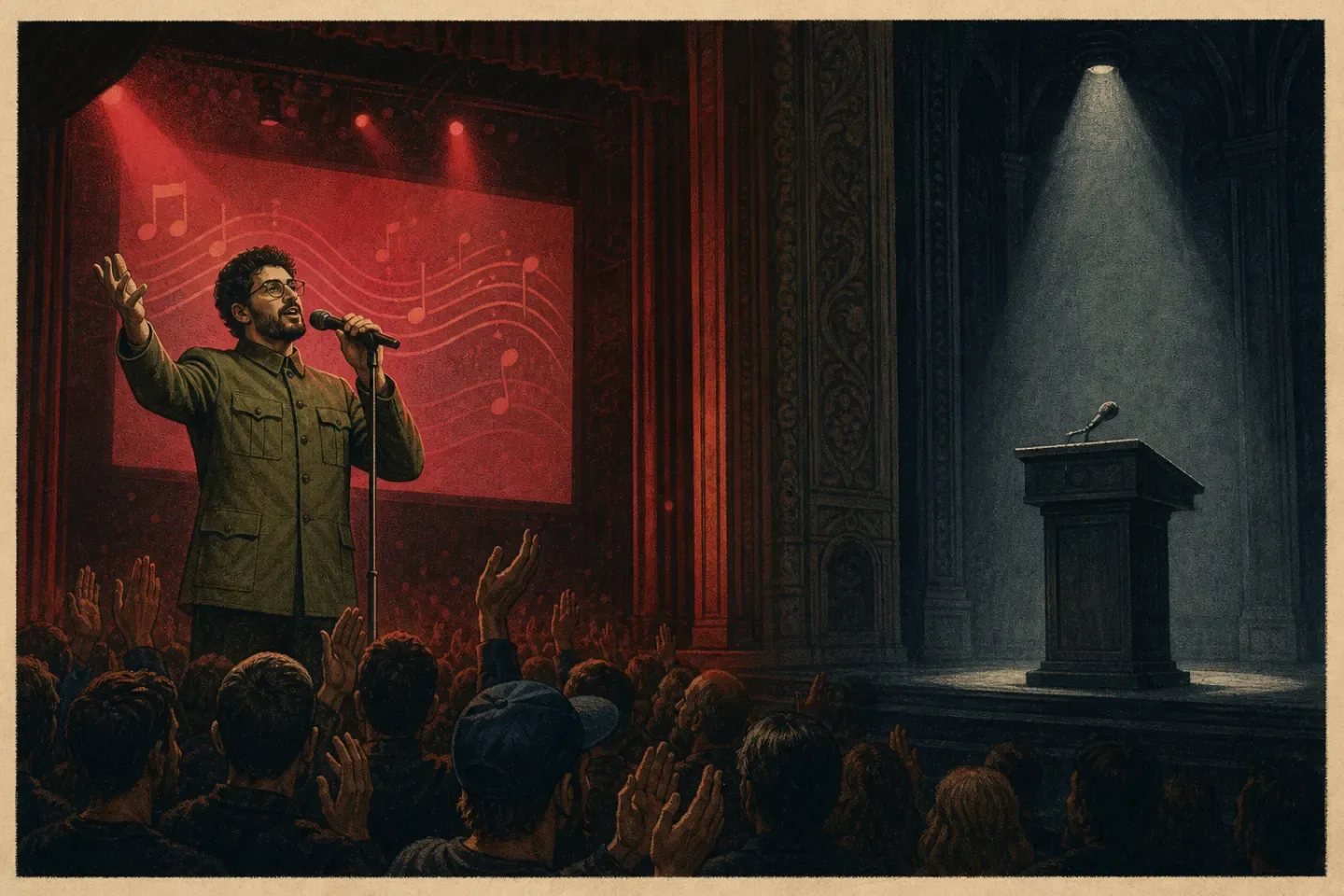
The socialist streamer did not offer an argument or challenge an idea. He transformed the murder of a political opponent into entertainment for a cheering crowd.
Hasan Piker has built an enormous career explaining that political rhetoric has consequences. Apparently, that principle comes with a convenient exception when the victim is a conservative.
During a live performance in San Francisco, Piker took the stage in a Mao-style costume and sang “We Are Charlie Kirk,” the viral song that emerged after Kirk’s assassination. The crowd laughed and cheered as the death of a husband, father and political organizer was repackaged as karaoke.
Piker’s defenders immediately reached for the usual escape hatch. The song had already become an internet meme, they argued. It was melodramatic, apparently generated with artificial intelligence and widely mocked by people who found the production absurd. Piker was supposedly ridiculing the song rather than celebrating the murder.
That defense might explain why someone laughed at a clip alone on a phone. It does not explain the decision to place the lyrics on a screen, perform the song before a theater audience and turn another man’s death into a communal punchline.
This was not criticism of Kirk’s politics. Piker did not challenge an argument about immigration, abortion, guns or the economy. He used Kirk’s murder as raw material for a live show because contempt is part of the product he sells.
The modern political influencer rarely needs to say exactly what he means. Irony provides deniability, and the audience already understands the assignment. If the performance receives applause, it was daring comedy. If normal people find it grotesque, everyone suddenly becomes a humorless scold who failed to understand the joke.
That arrangement allows cruelty to travel under the protection of ambiguity.
Piker understands this system better than almost anyone. He can spend hours condemning dehumanizing language from the Right, then retreat behind memes when his own audience is entertained by the death of someone it despised. The moral standard changes according to who is lying dead and who is holding the microphone.
Imagine a conservative personality leading a theater full of people in a mocking song about the murder of a prominent progressive activist. There would be no patient discussion about internet culture or the ironic history of the audio. The performance would be presented as proof of a diseased political movement. Every Republican who had ever appeared alongside the performer would be asked to denounce it.
That hypothetical reaction would be justified. Political assassination should not become crowd entertainment, regardless of the victim’s ideology.
Charlie Kirk made a career out of public confrontation. He entered hostile rooms, defended controversial positions and invited opponents to challenge him. People were free to reject his arguments, protest his events and criticize everything he represented. Murder removed the possibility of answering him with anything but a meme.
That should disturb anyone who claims to value political debate.
Piker’s performance also exposes the bargain progressive politicians make when they seek access to his audience. They want his reach, his young viewers and his ability to convert ideological resentment into cultural enthusiasm. They would prefer not to inherit the uglier parts of the spectacle, but influence does not arrive neatly separated from the influencer.
A movement cannot repeatedly court a man as a serious political voice and then insist that his public behavior is merely entertainment whenever accountability becomes inconvenient.
The issue is not whether Hasan Piker should be censored. He has every right to sing a tasteless song, dress like a communist dictator and show the country exactly what kind of political culture he represents. The public has the same right to judge him—and to judge the candidates and organizations that treat his platform as a respectable campaign stop.
The performance was revealing precisely because it required no leaked recording and no hostile interpretation. Piker stood before his own audience, under stage lights, and turned the assassination of a political opponent into a singalong.
Nobody forced him to do it. Nobody took it out of context.
The context was the show.

Claire Whitmore is a conservative writer covering culture, family, education, media, and the rapidly changing expectations placed on women in modern America. Her work examines the intersection between politics and everyday life, particularly debates surrounding motherhood, relationships, career expectations, schools, and popular culture. Whitmore is skeptical of political movements that treat traditional choices as inherently outdated and argues that genuine freedom requires allowing women to define success for themselves. At The Dispatch Room, she brings a measured but unapologetically conservative perspective to some of the country’s most contentious cultural debates.
Discussion
Loading discussion…