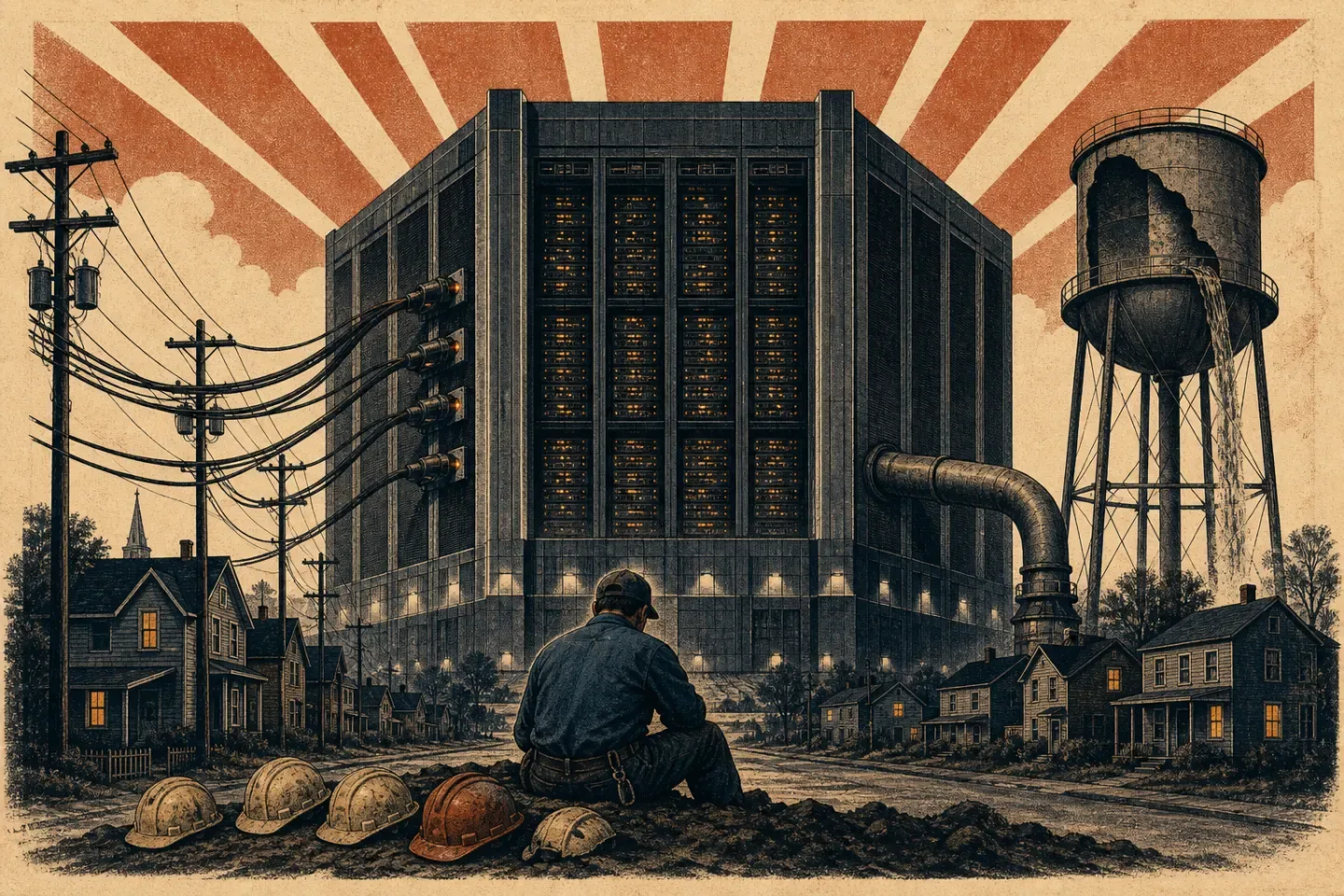
The AI boom has arrived with a familiar promise: subsidize the infrastructure now and prosperity will follow. Communities should inspect the bill before signing.
The sales pitch for the new data center usually arrives wrapped in the language of progress. There will be investment, construction and a gleaming monument to the artificial-intelligence economy. Local officials get a ribbon cutting. Corporate representatives get a tax package. Residents are told that the future has chosen their town.
Then somebody asks the unfashionable questions. How much electricity will it consume? Who pays for the grid expansion? How much water will its cooling systems require? How many permanent jobs remain after the construction crews leave?
Those questions are becoming harder to dismiss because the numbers are no longer small. A 2025 update from Lawrence Berkeley National Laboratory estimated that data centers could consume nearly 12 percent of all American electricity by 2030. That is not a niche industrial load. It is a national transformation of the power system, driven largely by companies wealthy enough to finance their own infrastructure.
Yet the public is repeatedly asked to help finance it for them.
At least 38 states offer incentives aimed specifically at attracting data centers. The usual justification is economic development, but these facilities are unusual factories: their principal products are computing power and heat, and their production floors do not require armies of local employees. Construction can support substantial temporary work. Once a facility is running, however, the permanent workforce may be modest compared with the enormous capital investment, electricity demand and tax concessions involved.
That does not make data centers useless. It makes the bargain worthy of scrutiny.
The Future Should Pay Its Own Electric Bill
Artificial intelligence will require more computing capacity, and America should prefer that capacity be built here rather than handed to China. A reflexive national ban would be foolish. So would allowing every proposal to be treated as a patriotic emergency that excuses ordinary questions about costs.
New York has imposed a temporary pause on new hyperscale projects while it develops rules intended to keep ratepayers from financing transmission and infrastructure for them. Pennsylvania now requires proposals seeking state permits to meet new infrastructure standards and gives local communities a larger voice. In Texas, Governor Greg Abbott ordered an audit of projects moving through the state's grid-interconnection process.
That is not the work of one ideological faction. It is what happens when governors from different parties discover that the AI boom has consequences outside Silicon Valley.
The conservative answer should not be to socialize the costs because the companies involved use words such as innovation. If a trillion-dollar industry requires more generation, substations, transmission and water capacity, it should pay the full cost of bringing those resources online. Existing families and small businesses should not receive higher bills so that some of the richest corporations on earth can obtain discounted electricity.
Nor should a tax exemption be praised as job creation before anyone counts the jobs. Washington state's legislative auditors recently examined an urban data-center preference that beneficiaries said produced 53 family-wage positions and nearly 300 temporary construction jobs. Their recommendation was to let the preference expire because it had not caused new data centers to be built.
That is what accountability looks like: compare the promise with the result, then stop paying for what did not work.
Innovation Is Not a Blank Check
The emerging data-center fight does not fit neatly into the old culture-war boxes. Environmental groups worry about water and emissions. Homeowners worry about utility bills, noise and transmission lines. Workers wonder why a development advertised as an employment engine needs so few people after opening. Conservatives should recognize the common thread: distant institutions want local communities to accept concentrated costs in exchange for benefits that are often vague, delayed or impossible to verify.
There can be good projects. A developer that finances the necessary grid upgrades, discloses its resource demands, pays an honest tax bill and delivers enforceable community benefits should be allowed to build. Towns capable of negotiating favorable property-tax revenue may reasonably decide that the trade is worthwhile.
But consent requires information, and a real market requires prices that reflect costs. Secret incentive packages and special electricity arrangements corrupt both.
Big Tech has spent years warning that AI will replace workers across wide sections of the economy. Now some of the same firms want communities to subsidize the physical infrastructure that makes that replacement possible, often while describing a relatively small permanent staff as an employment revolution. The audacity is almost impressive.
America needs computing power. It also needs affordable electricity, reliable water systems and local governments that remember whom they represent. Those goals can coexist if politicians negotiate instead of genuflect.
Build the data centers where the economics make sense. Make their owners pay for the burden they place on the grid. Demand measurable benefits before granting tax privileges. Put every promise in writing and revisit it after the cameras leave.
The future may run on servers. That does not mean ordinary Americans should be forced to pick up their tab.

Naomi Carter is a conservative columnist whose work focuses on women, identity politics, gender, race, media, and the cultural institutions influencing younger Americans. Carter became increasingly skeptical of progressive politics after seeing complex questions of identity reduced to rigid ideological categories. Her writing challenges political orthodoxies on both race and gender while emphasizing individual agency, personal responsibility, free expression, and equal treatment under the law. At The Dispatch Room, Carter frequently examines how political narratives are created, amplified by media and institutions, and ultimately experienced by ordinary people.
Discussion
Loading discussion…