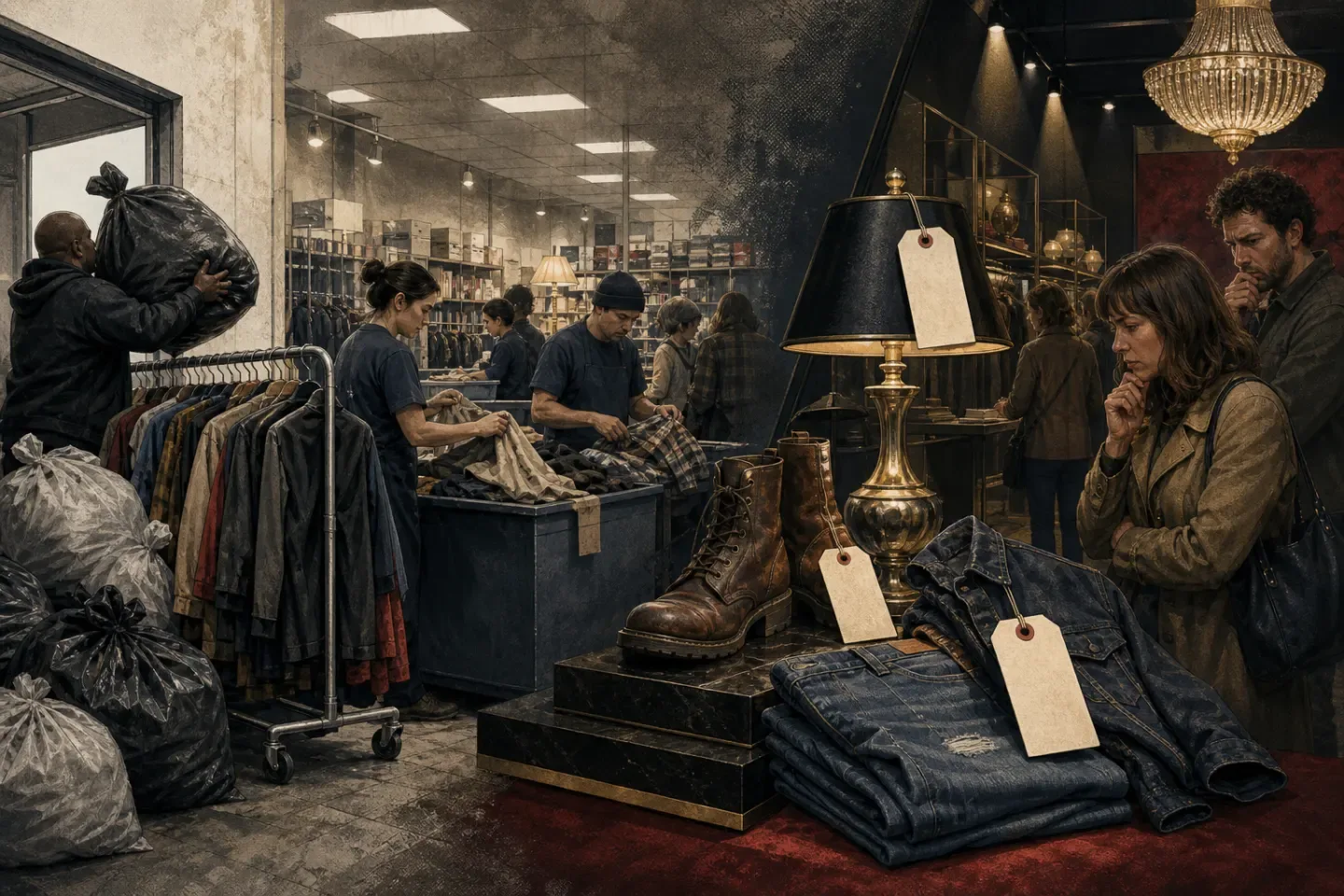
Shoppers are finding used clothing, battered furniture and donated household goods priced like new merchandise. The thrift-store bargain is beginning to feel broken.
The latest symbol of America’s cost-of-living crisis is not sitting in a grocery aisle or on a car dealer’s lot. It is hanging from a plastic rack beneath fluorescent lights with somebody else’s name written inside the collar.
Across social media, frustrated Goodwill shoppers are photographing used boots priced at nearly $70, ordinary shirts presented as “vintage” and scratched household items carrying tags uncomfortably close to the cost of buying them new. The individual examples vary by store, but the complaint is remarkably consistent: When did the thrift shop start pricing itself like a boutique?
The frustration begins with an unavoidable fact. Goodwill receives much of its merchandise as donations. Families clean out their closets, load bags into the car and hand over clothing, furniture and electronics without receiving payment.
That does not mean the merchandise costs Goodwill nothing to sell. Employees must collect it, sort it, inspect it, price it and place it on a sales floor. Stores have rent, electricity, insurance and disposal expenses. Large quantities of unusable junk arrive alongside the valuable donations. Goodwill’s retail revenue also supports employment training and other community programs.
Those facts deserve acknowledgment. They do not settle the argument.
Goodwill’s business model has always rested on an unwritten social bargain. Donors provide merchandise freely because they believe their unwanted possessions will serve another purpose. Shoppers tolerate crowded racks and unpredictable quality because they expect genuinely affordable prices. The organization earns revenue for its mission by connecting the two groups.
When used merchandise begins approaching ordinary retail prices, that bargain starts to collapse.
A shopper buying a secondhand appliance does not receive a manufacturer’s warranty. A pair of donated jeans may be faded, stretched or several seasons old. A scratched table does not become a premium product because somebody searched for a similar model online.
Yet thrift-store pricing increasingly appears influenced by the same internet marketplaces that turned every attic into a speculative investment portfolio. Employees can identify recognizable brands in seconds. Valuable donations can be listed online instead of reaching a neighborhood sales floor. Ordinary items acquire optimistic prices because somebody, somewhere, once asked that amount on eBay.
Goodwill itself says some donations are better suited to its online auction marketplace and that obtaining the greatest value allows local organizations to fund more services. That reasoning makes financial sense. It also changes what customers reasonably expect to find inside the stores.
The thrill of thrifting was built around possibility. A shopper invested time searching through hundreds of unwanted items and occasionally discovered something unusually valuable. The bargain rewarded knowledge, patience and luck.
If every promising donation is pulled aside, researched and auctioned to the highest bidder, the physical store becomes a room full of leftovers priced by people who still expect internet margins.
Resellers receive much of the blame for this transformation. They descend on stores, scan labels and convert underpriced merchandise into online profit. Goodwill understandably does not want someone else capturing all the value of its donations.
But a nonprofit cannot organize its entire retail strategy around defeating resellers without affecting the single mother buying school clothes, the retiree furnishing an apartment or the ordinary customer trying to make a paycheck stretch another week. A policy designed to extract every possible dollar from professional flippers extracts it from everyone else too.
There is also an important distinction that online outrage often misses: Goodwill is not one centrally managed chain setting identical prices nationwide. It is a network of locally operated organizations. Prices, programs and practices differ from one region to another.
That makes sweeping claims difficult, but it also creates a simple opportunity for accountability. Local Goodwill organizations should publish clearer information showing how retail revenue supports their programs, how prices are determined and how much desirable merchandise remains available inside neighborhood stores rather than being diverted online.
They could also adopt basic customer protections: stop pricing used products above readily available new equivalents, distinguish genuinely collectible merchandise from ordinary old clothing and reserve a meaningful portion of quality donations for local shelves.
Goodwill does not owe every shopper a hidden treasure. It does owe donors and customers a transparent explanation of what their generosity is funding and whom the stores are meant to serve.
The name “Goodwill” carries expectations that do not apply to an ordinary retailer. People donate because they believe they are participating in something charitable. Customers shop there because the stores historically offered affordability, reuse and the possibility that somebody else’s castoff could make their own life a little easier.
Once a thrift store begins behaving like a luxury reseller with free suppliers, the public is entitled to ask whether the mission is driving the business—or whether the business has swallowed the mission.
Goodwill can maximize the price of every donated object, or it can preserve the trust that made people donate in the first place.
It may discover that it cannot do both.

Naomi Carter is a conservative columnist whose work focuses on women, identity politics, gender, race, media, and the cultural institutions influencing younger Americans. Carter became increasingly skeptical of progressive politics after seeing complex questions of identity reduced to rigid ideological categories. Her writing challenges political orthodoxies on both race and gender while emphasizing individual agency, personal responsibility, free expression, and equal treatment under the law. At The Dispatch Room, Carter frequently examines how political narratives are created, amplified by media and institutions, and ultimately experienced by ordinary people.
Discussion
Loading discussion…