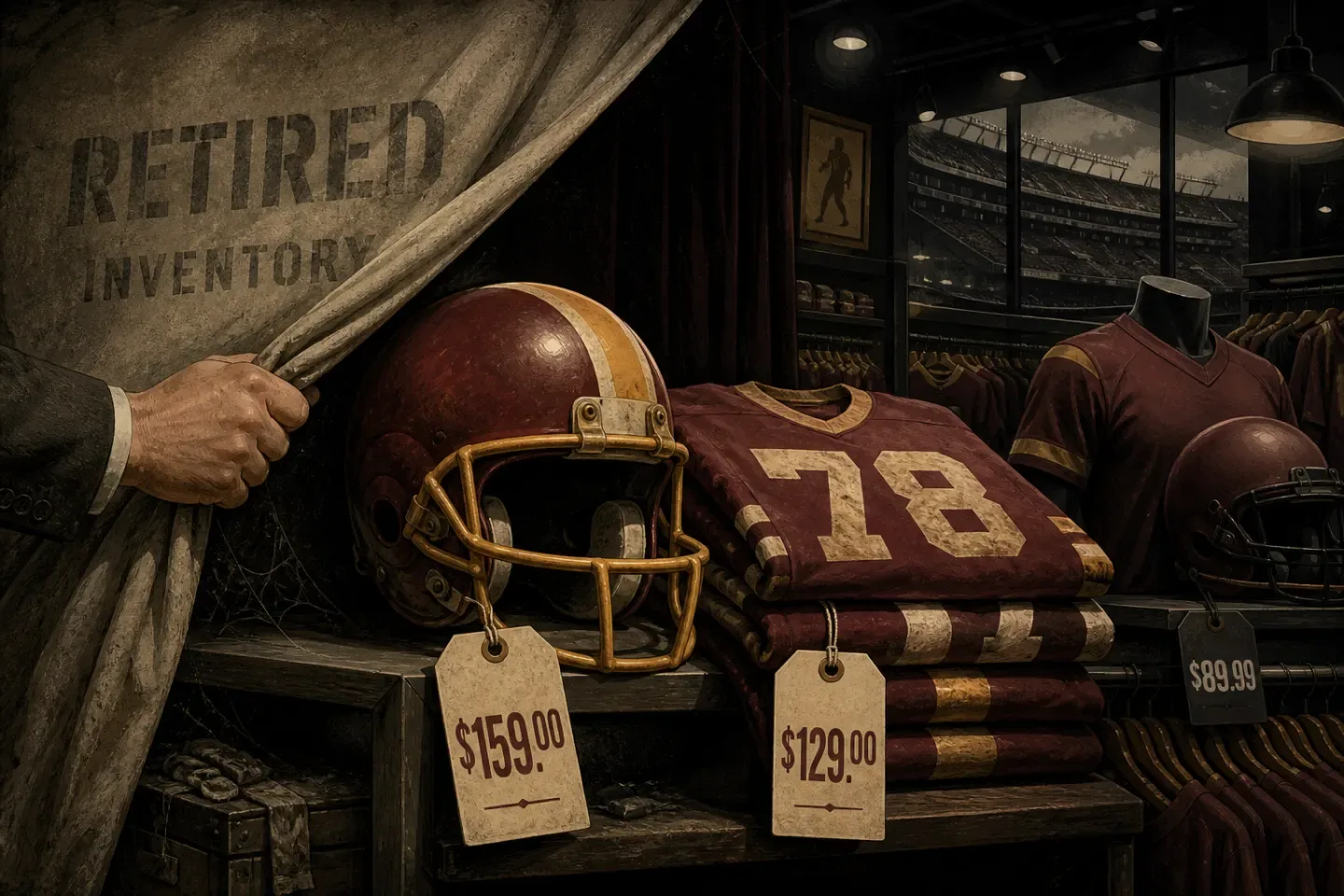
Washington has not restored its former team name. It has done something more revealing: put the supposedly forbidden identity back on the shelf with a price tag attached.
The old Washington football name is back—not on the scoreboard, not at midfield and certainly not in an apologetic press release. It has returned in the one place where corporate principles tend to become remarkably flexible: the merchandise counter.
Throwback gear bearing the Redskins name is reportedly available through the Commanders’ stadium shop and online. The team has not reversed the rebranding, and nobody should pretend otherwise. This is a limited merchandise decision. But that distinction does not make the story less revealing. It makes it more revealing.
If the old identity was so offensive that it had to be removed from public life, why is it acceptable when printed on an expensive jersey?
Washington abandoned the Redskins name in 2020 after years of pressure from activists, corporate sponsors and media institutions. The decision was presented as a moral necessity. The name was not merely outdated, according to the prevailing argument. It was beyond the boundaries of respectable use. The organization eventually became the Commanders, and everyone was expected to treat the debate as finished.
Apparently, the debate becomes less finished when customers still want the old merchandise.
The Cash Register Has a Better Memory
This is the familiar pattern of corporate activism. Executives adopt the fashionable moral language of the moment, congratulate themselves for taking a courageous stand and then quietly search for a way to keep earning money from the audience they just lectured.
The fans never forgot the name. For millions of people, it was attached to family traditions, Sunday afternoons, famous players and decades of Washington football. That does not erase every criticism of the word, but it does explain why so many supporters rejected the idea that their attachment was rooted in malice.
The rebranding campaign flattened all of that history into a morality play. Activists were enlightened. Fans who objected were backward. Corporate management stood bravely on the right side of history—after sponsors made clear which side was financially safer.
Now the financial incentives have shifted just enough to place the old identity back under the stadium lights.
The organization wants the emotional power of the Redskins legacy without admitting that the people who defended that legacy may have had a point. It wants the nostalgia, the sales and the visual history while maintaining the official fiction that the former name is too objectionable for ordinary use.
That is not moral clarity. It is brand management.
Yesterday’s Offense, Today’s Vintage Collection
Defenders of the merchandise decision can make a reasonable distinction between restoring a current team name and selling historical apparel. Sports franchises sell throwbacks all the time. Preserving history is not necessarily the same as endorsing every part of it.
Fair enough. But that argument requires precisely the nuance that was denied when the name was retired.
If historical context can make the old branding acceptable on a jersey today, then perhaps the subject was never as simple as activists claimed. Perhaps a symbol can carry different meanings for different people. Perhaps the fans who associated it with football rather than hostility did not deserve to be treated as participants in some national moral failure.
Corporate America rarely admits that kind of error. It simply changes the packaging.
The supposedly forbidden name is now “heritage.” The offensive logo becomes a “throwback.” The history that had to be scrubbed from the present can be resold as nostalgia, provided the transaction clears at the register.
Nobody at the top has to apologize. Nobody has to acknowledge that the public scolding went too far. The institution gets to preserve its progressive credentials while collecting revenue from the identity it discarded.
The Price Tag Says What the Press Release Will Not
This merchandise does not mean the Redskins name is officially returning. It does not settle the broader argument over whether it ever should. What it does is expose how quickly declarations of corporate principle become negotiable when a valuable market remains.
If Washington truly believed the old identity was unfit to be seen, it would not sell it. If the organization now believes the name can be presented as part of its history, it should say so honestly and extend some grace to the fans who never stopped believing that.
Instead, the team appears to have chosen the most corporate solution imaginable: keep the new name, sell the old one and hope nobody notices the contradiction.
The activists got their rebrand. The executives kept the revenue. The fans are being invited to buy back a piece of the history they were told had to disappear.
Sometimes a price tag tells the truth more clearly than any press conference.

Marcus Bennett is a conservative commentator focused on crime, education, economic opportunity, urban policy, and American culture. Raised in a working-class community outside Atlanta, Bennett developed his politics around the belief that public policy should be judged by results rather than intentions. His columns frequently examine failing institutions, public safety, family stability, educational reform, and the political assumptions surrounding Black Americans. Bennett brings a skeptical, data-driven approach to political arguments and has little patience for ideological explanations that fail to match conditions on the ground.
Discussion
Loading discussion…