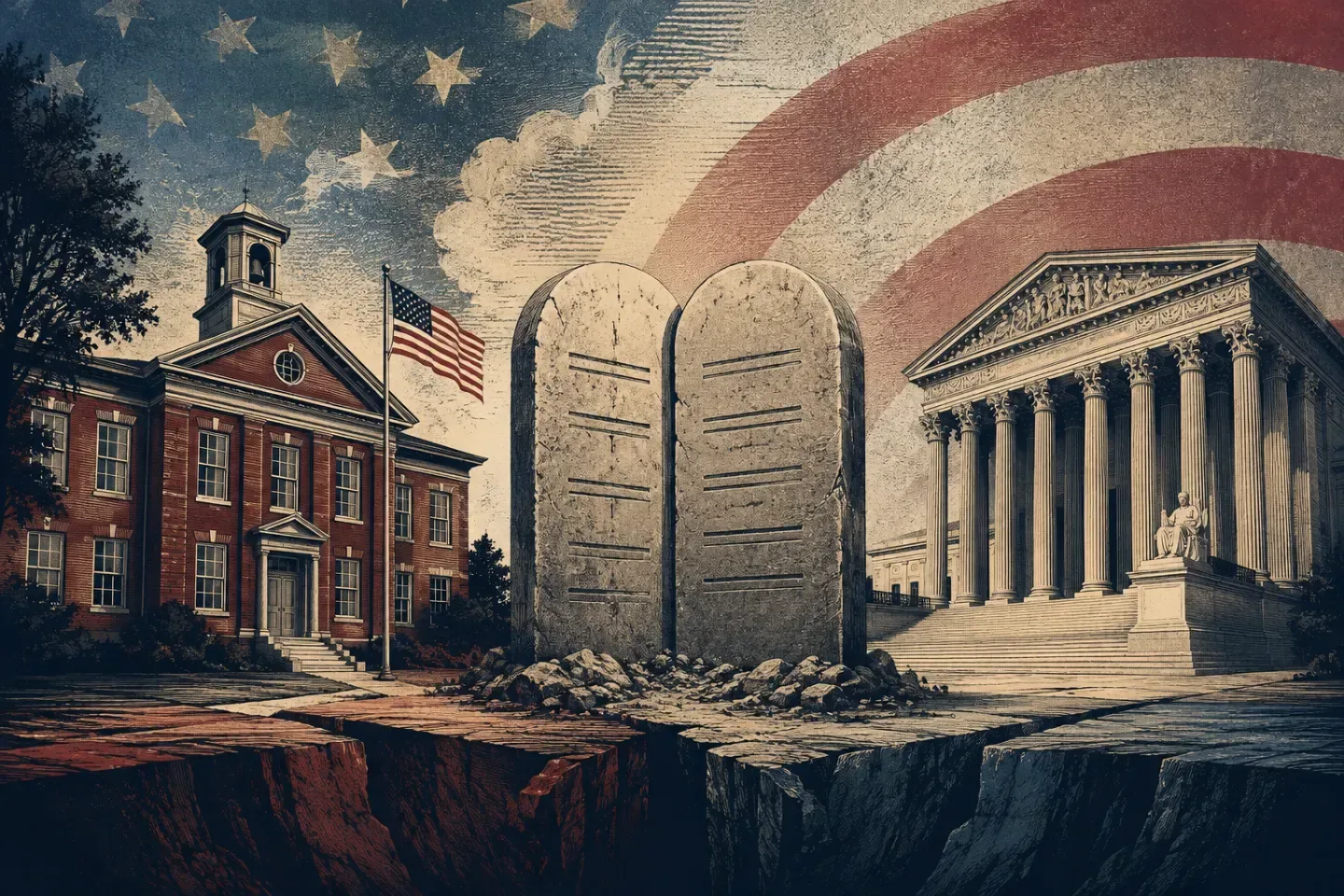
Texas has placed history, religion and parental authority on a collision course—and the justices may soon have to draw a new constitutional line.
The argument over the Ten Commandments in public-school classrooms is moving toward the Supreme Court again. Families challenging a Texas law have asked the justices to review an appeals-court decision allowing the state to require donated displays in classrooms.
Supporters describe the commandments as foundational moral instruction with an undeniable place in the history of Western law. Opponents argue that a permanent state-mandated display endorses a particular religious text and intrudes on parents’ authority over their children’s religious formation.
Both sides understand that the fight is larger than a poster.
For decades, the cultural left treated almost every acknowledgment of Christianity in public life as a constitutional emergency. Prayer disappeared, religious symbols became litigation targets, and the language of neutrality often produced a public square scrubbed clean of the country’s dominant religious inheritance.
Conservatives are right to challenge that manufactured amnesia. Students should know that biblical ideas shaped American rhetoric, law, abolitionism, civil rights and the moral vocabulary of generations. Teaching that history is not the establishment of a church.
Yet a state mandate presents a harder question than teaching historical influence. Texas has selected a specific text for continuous display in every classroom covered by the law. Christian, Jewish and other traditions do not all number or phrase the commandments identically. Families who support religious education may still object to politicians choosing its wording and presentation.
The conservative case should therefore rest on history, democratic authority and the absence of coercion—not on the claim that every religious display is automatically constitutional. Opponents, meanwhile, must explain why exposure to a historic religious text is uniquely dangerous when schools routinely surround students with official declarations about values, identity and social justice.
The Supreme Court’s modern religious-liberty decisions have moved away from the old assumption that government must sterilize public institutions of religious reference. A Texas case could clarify how far that correction extends inside compulsory public education.
There is room for a principled distinction. Schools may teach the commandments, discuss their influence and display them as part of a broader historical presentation. Whether the government may require one standalone version in every classroom is the sharper constitutional issue now being presented.
The justices have not yet agreed to hear the case. If they do, Americans should reject the caricatures. The choice is not between theocracy and hostility to faith. It is between competing understandings of history, government speech and the rights of parents who do not all believe the same thing.
That is precisely why the Court should take the case and provide a rule the country can understand.

Claire Whitmore is a conservative writer covering culture, family, education, media, and the rapidly changing expectations placed on women in modern America. Her work examines the intersection between politics and everyday life, particularly debates surrounding motherhood, relationships, career expectations, schools, and popular culture. Whitmore is skeptical of political movements that treat traditional choices as inherently outdated and argues that genuine freedom requires allowing women to define success for themselves. At The Dispatch Room, she brings a measured but unapologetically conservative perspective to some of the country’s most contentious cultural debates.
Discussion
Loading discussion…