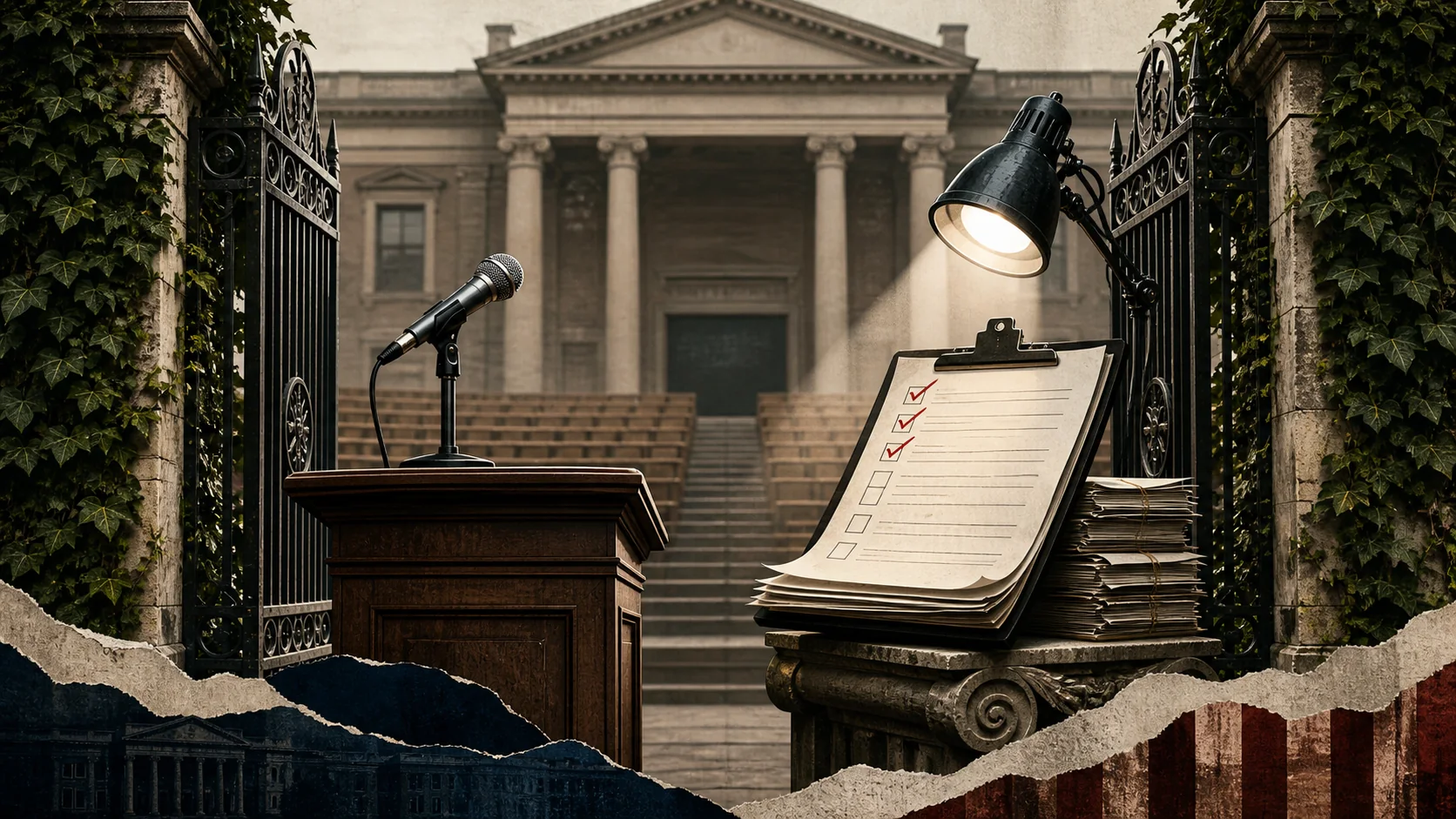
Colleges spent years regulating speech, narrowing acceptable opinion, and demanding ideological statements. Now a federal request for public transparency has them reaching for the language of independence.
Nothing revives a university’s belief in limited government quite like government asking the university to explain itself.
After years of speech codes, bias-response systems, ideological hiring practices, disruptive protests, and administrative bloat, higher education has suddenly rediscovered the majestic language of institutional independence.
The timing is exquisite.
Education Secretary Linda McMahon issued a national call to action on August 3 asking colleges and universities to publish statements by the end of 2026 describing their commitments across seven areas.
Those areas include admissions, campus speech, intellectual pluralism, affordability, academic rigor, foreign influence, and service to the national interest.
In other words: What are you doing, why are you doing it, and are you willing to say it where parents can read it?
For parts of higher education, this apparently qualifies as an existential threat.
Transparency Is Not Tyranny
The new request is materially less prescriptive than an earlier compact proposed by the administration. It announces no new funding condition, certification requirement, or enforcement mechanism on its face.
That matters.
Federal coercion is real, and conservatives should not pretend otherwise merely because the current administration shares some of their priorities.
Washington has no business dictating every syllabus, faculty appointment, research conclusion, or campus controversy.
But asking institutions to state their policies publicly is not the same as ordering the result.
Universities demand transparency from corporations, churches, police departments, political campaigns, donors, and nearly every institution they study.
They can survive a little sunlight themselves.
If a college believes its admissions system is fair, publish the principles.
If it protects free expression, show the policies.
If its departments contain genuine intellectual pluralism, present the evidence.
If tuition reflects value rather than bureaucratic expansion, explain the arithmetic.
This should be easy.
The panic suggests it may not be.
Academic Freedom for Me, Compliance Training for Thee
Higher education’s credibility problem did not begin with the Trump administration.
It began when universities treated freedom as a privilege enjoyed by administrators and a risk managed among everyone else.
Students learned that some speech was protected inquiry while other speech created an unsafe environment.
Faculty candidates learned that intellectual ability might not be enough unless accompanied by approved commitments to institutional ideology.
Professors learned that a complaint could become a process, and the process itself could become the punishment.
Then the same institutions issued declarations about open inquiry.
Americans noticed the contradiction.
The federal request did not create public distrust. It arrived because public distrust was already there.
Reform Is Possible
The University of Alabama recently earned the Foundation for Individual Rights and Expression’s top “green light” rating after revising policies concerning peer harassment and removing a confusing technology guideline.
FIRE reported that Alabama became one of 75 institutions nationwide with that rating.
That example matters because it shows that reform does not require burning down the university.
Policies can be clarified. Protected speech can be restored. Institutions can work with outside civil-liberties organizations and improve.
No loyalty oath is necessary.
No federal curriculum is necessary.
Just rules that mean what they say and apply to everyone.
Conservatives Should Watch Washington Too
There is a temptation on the Right to cheer every federal demand aimed at institutions conservatives distrust.
Resist it.
A power used today to demand intellectual pluralism can be used tomorrow to demand ideological conformity in the opposite direction.
Universities should not become branch offices of the Department of Education.
But neither should they receive public money, public privilege, and cultural authority while hiding behind autonomy whenever anyone asks a difficult question.
The proper conservative position is accountability with limits.
Require disclosure. Enforce existing civil-rights law. Protect constitutional speech. Make funding decisions transparent. Then leave professors free to reach conclusions politicians dislike.
That is academic freedom.
Not immunity from criticism.
Publish the Receipts
The administration has asked colleges to tell the public where they stand.
Good.
Every university website has room for glossy claims about excellence, inclusion, global impact, sustainability, innovation, belonging, and transformation.
Surely it can spare one page for admissions standards, speech protections, viewpoint diversity, costs, foreign funding, and academic rigor.
If higher education’s policies are defensible, the statements will strengthen public trust.
If the policies cannot survive being written in plain English, the problem is not federal intimidation.
The problem is that Americans finally asked for the receipts.
Claire Whitmore is a conservative writer covering culture, family, education, media, and the rapidly changing expectations placed on women in modern America. Her work examines the intersection between politics and everyday life, particularly debates surrounding motherhood, relationships, career expectations, schools, and popular culture. Whitmore is skeptical of political movements that treat traditional choices as inherently outdated and argues that genuine freedom requires allowing women to define success for themselves. At The Dispatch Room, she brings a measured but unapologetically conservative perspective to some of the country’s most contentious cultural debates.
Discussion
Loading discussion…