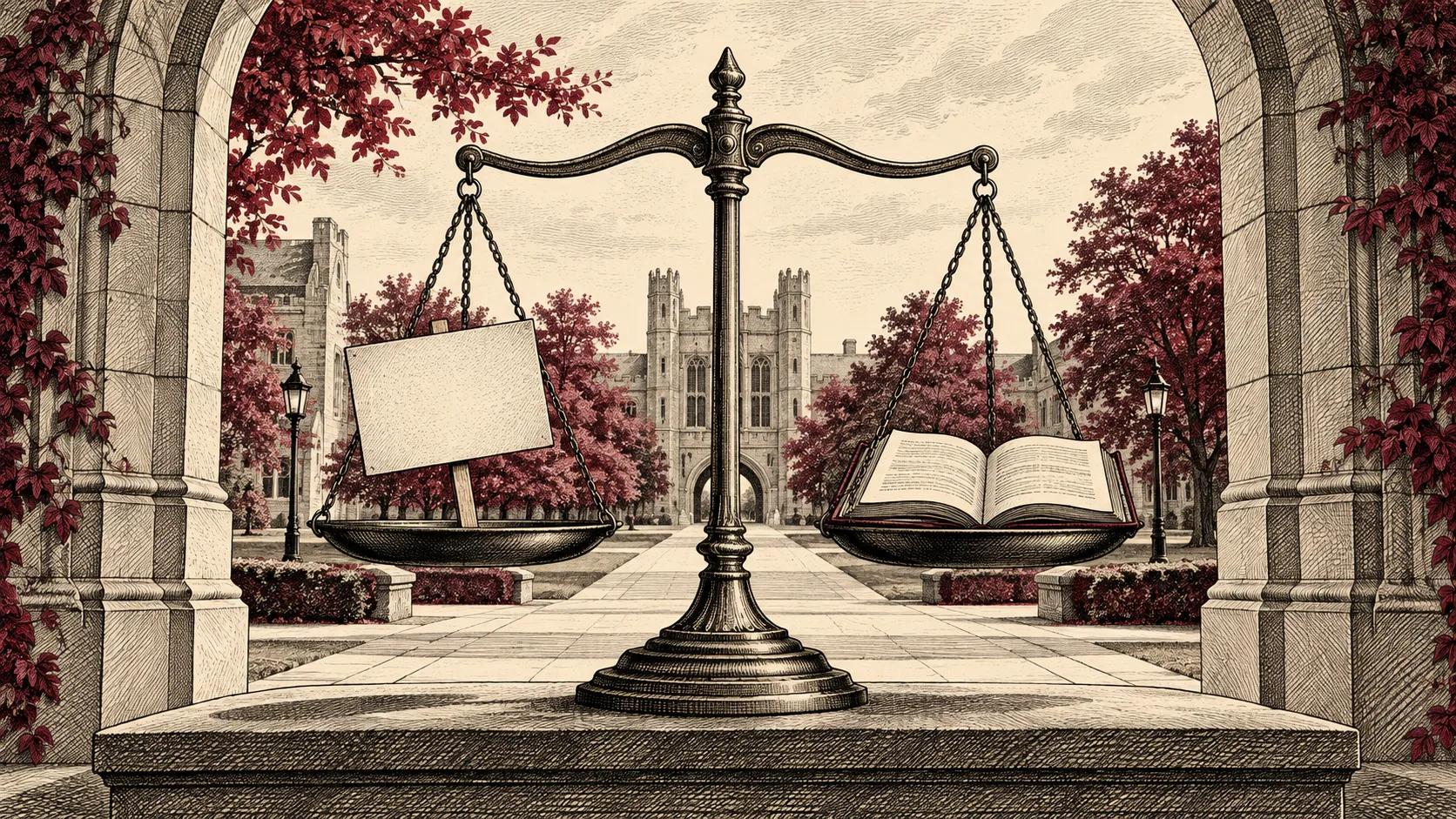
UT-Austin won a protest-rights case. The broader lesson is consistent rules, fair process and room for both dissent and learning.
A university has an obligation to protect unpopular speech. It also has an obligation to the students who came to study, attend class and use the campus without having their education reorganized around somebody else’s political campaign.
Those duties can collide. Pretending that only one of them matters is how a campus turns a difficult judgment into a recurring ideological fight.
The Texas Tribune reported September 24 that a federal judge ruled UT-Austin did not violate former student Ammer Qaddumi’s First Amendment rights by canceling an April 2024 pro-Palestinian protest and subsequently suspending him. His three-semester suspension remains on his disciplinary record.
Judge Robert Pitman found the university reasonably anticipated substantial disruption. But he also criticized its rushed handling and recognized that Qaddumi had valid reasons to believe his rights had been violated. The Tribune reported that an appeal was not immediately clear.
That is a more complicated outcome than a victory slogan suggests. It supports the university’s decision in this case without making every administrative decision wise or every future restriction justified.
Rules cannot depend on whose cause is fashionable
The conservative argument for campus order should be straightforward: shared facilities require shared rules. Political conviction cannot grant one group permanent priority over everyone who pays tuition or works there.
A demonstration can be passionate and inconvenient without losing protection. There is also a meaningful difference between expressing a position and claiming authority over how an institution operates. Universities should explain where their rules draw that line before a confrontation, apply them consistently and give accused students a fair opportunity to respond.
An administrator who indulges disruption for a favored cause and discovers strict enforcement for an unfavored one deserves criticism. So does an administrator who uses a vague prediction of trouble to shut down a viewpoint. Neither practice becomes principled because the people applauding it change.
For conservatives, this is a test of whether the argument is really about rules. The standards we defend for a pro-Palestinian protest must remain defensible when the next gathering concerns abortion, immigration or religious liberty.
A court victory is not the end of accountability
Students should be able to challenge a suspension without being accused of hostility to education. Universities should be able to defend reasonable restrictions without being treated as enemies of every form of protest. Courts exist partly because those competing claims cannot be settled by whoever produces the loudest statement.
The practical lesson for university leaders is to make decisions that can survive examination: clear policies, documented reasons, consistent treatment and a fair disciplinary process. Winning a case should encourage that discipline, not replace it with institutional self-congratulation.
And activists should recognize that persuading a community is different from demanding control over it. An important cause still has to coexist with other people’s rights and responsibilities.
A university worth defending must leave room for dissent and room for education. Students should not have to choose between the two.

Daniel Mercer is a conservative political writer specializing in elections, government, foreign policy, and the growing power of America’s political and administrative institutions. His work focuses on how decisions made in Washington affect ordinary Americans far beyond the capital. Mercer is particularly interested in executive power, government bureaucracy, media influence, immigration, national security, and the evolution of the Republican Party. At The Dispatch Room, he approaches politics from a pragmatic conservative perspective, separating political theater from the decisions and institutions that actually shape public policy.
Discussion
Loading discussion…